
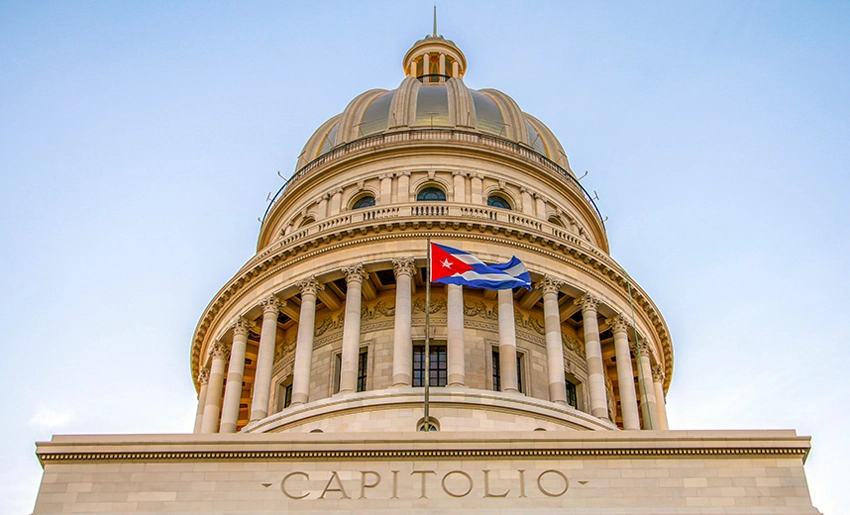
In a context marked by multiple challenges, the National Assembly of People’s Power (ANPP) of Cuba will hold its Sixth Session of the Tenth Legislature on December 18th, with a significantly revised format and agenda.
The decision, adopted by the Council of State, responds to a comprehensive assessment of the country’s situation and aims for maximum resource efficiency. The details of this adaptation were explained at length by the Secretary of the ANPP and the Council of State, Homero Acosta Álvarez, and by the coordinator of the ANPP Commissions, Marta Hernández Romero, during Friday’s edition of the Round Table program.
Homero Acosta Álvarez began his remarks by noting that, in accordance with the law. The convocation for this ordinary session was issued more than twenty days in advance. Scheduled for December 18th at 9:00 a.m. at the Convention Palace. Following a prior meeting of the standing committees.
However, on December 10th, the Council of State conducted an in-depth analysis of the national situation. “The Council was analyzing the situation facing the country, which is, let’s say, known to everyone: the electricity situation. The current economic situation, the difficulties posed by the pandemic, and the country’s health and sanitation situation,” Acosta explained.
This combination of factors, he argued, creates “a complex situation for the assembly’s proceedings. Also due to the issue of the rational use of resources.” It was on this basis that, also following a directive from the PCC leadership to hold a plenary session via videoconference in a single day, the Council of State decided to “reduce and readjust the session’s agenda.” This is not an unprecedented measure, but rather one based on the experience gained during the COVID-19 pandemic. When the National Assembly of People’s Power (ANPP) successfully conducted its entire legislative process and parliamentary activity using this online modality.
Which issues are urgent?
The main challenge was selecting, from a broad, pre-designed work program, the matters that, by their nature, could not be postponed. Acosta Álvarez explained the methodology used. The ANPP’s initial agenda is not improvised. It stems from a regularly followed legislative schedule and the body’s oversight and auditing powers.
It included, for example, the accountability report of the Ciego de Avila provincial government. A thorough audit of the Ministry of Justice, the accountability report of the Ministry of Science, Technology and Environment, and several legal regulations in process.
“When analyzing the issue and seeking the greatest rationality, the question arose: what topics should we address?” he recounted. A core set of economic issues was identified that are inherent to the December session and structural for the country: the Economic Plan and the Budget Law. “There is an economic plan, the objectives and goals of the economic plan for the following year. Which we discussed in December… therefore, that was mandatory.
“A budget law must be approved. A country has to have a budget law. It couldn’t function… There are no plagues in Cuba. No, I’m not going to compare. No, there are no plagues in Cuba. The government here is a serious government, it’s a serious parliament where a budget is approved every year,” he argued.
In addition to these two economic issues, other essential topics were addressed:
- The swearing-in of eight deputies elected by the municipal assemblies to fill vacancies.
- A review of agreements adopted in previous sessions, an ongoing oversight process.
- The analysis and evaluation of the Government Program to correct distortions and revitalize the economy, which will be presented by the Prime Minister. Acosta Álvarez emphasized the importance of this point, as it “affects all sectors of society” and its discussion is part of a broader political process of debate within institutions, unions, the party, and youth groups. “It’s a way to keep the public updated on the program’s progress,” he stated.
- Two bills in advanced stages: the Science, Technology, and Innovation Law and the Law for the Exceptional Reduction of the Term of Office for Delegates to the Municipal Assemblies. The latter being crucial for adjusting next year’s electoral calendar.
- The updated legislative schedule, presented by the Minister of Justice.
- The ratification of the agreements and decree-laws issued by the Council of State in the last six months, a constitutional procedure.
Moreover the postponed items, such as the aforementioned specific oversight actions and the draft Law on Land Use, Tenure, and Possession, will continue to be addressed in the ongoing work of the committees and will be taken up again in future sessions.
Committees during the adjusted period: Virtual plenary sessions and specialized meetings
Due to the new format, the dynamics of the committees have also been adapted. Only three will hold plenary sessions (via videoconference) on December 17th. As they have the legal obligation to examine and issue opinions on the bills that will be submitted to the plenary session on the 18th: the Committee on Economic Affairs, the Committee on Constitutional and Legal Affairs, and the Committee on Education, Culture, Science, Technology, and the Environment.
Also the other eight committees will not meet in plenary session, but will hold smaller, informal meetings and exchanges on the 17th. In these meetings, the results of completed audits will be presented and discussed with the relevant Central State Administration agencies. Marta Hernández listed some of these topics:
- Results and impact of the foreign currency financing schemes already approved and operational.
- Status of the school year and the quality of education.
- Status of the National Electrical System and the functioning of the municipal energy councils.
- Compliance with the action plans derived from previous accountability reports.
- Status of the fund for the development of transportation (passengers and freight).
- Distribution of products in the regulated basic food basket, in conjunction with the Ministry of Domestic Trade.
- Prevention of chronic non-communicable diseases and an update on the fight against arboviruses. The committees will meet later to continue addressing the remaining issues. But for this ordinary session, three main objectives have been defined to guide the work of the deputies.
Futhermore the first objective focuses on evaluating the results achieved within the government program for 2025. In this regard, the importance of addressing substantive issues. Such as macroeconomic stabilization, increased food production, higher foreign exchange earnings, combating crime, and strengthening social policies was emphasized.
The second objective is related to the need for the deputies’ analyses to reflect the main criteria, opinions, and concerns of the population. Gathered through the numerous exchanges held.
Finally, the third objective aims to ensure that the agreements reached commit all participants: deputies, organizations, and even the public, in order to transform the identified problems.
With information from Cubadebate

- Pexac Holguin Workshop Ensures Equipment Functionality - 14 de March de 2026
- The Profession of Earning a Living - 14 de March de 2026
- Taymara Oropesa advances to semifinals of the Badminton Tournament - 14 de March de 2026