
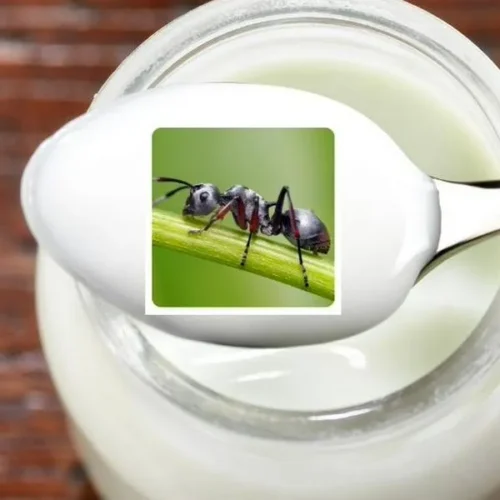
Danish research published in the journal iScience has managed to recreate a nearly forgotten Balkan and Turkish yogurt recipe that uses ants in its production.
Futhermore the study shows that the bacteria, acids, and enzymes present in ants can boost the fermentation process that turns milk into yogurt. The work also highlights how traditional practices can inspire new approaches in food science. Even bring creativity to the table.
“Today’s yogurts are often made with just two bacterial strains.” Explains lead author Leonie Jahn of the Technical University of Denmark.
“If we look at traditional yogurt, we see that its biodiversity is much greater. Varying by location, household, and season. This adds more flavors, textures, and personality,” she adds.
Also to better understand how to use ants to make yogurt, the researchers visited co-author and anthropologist Sevgi Mutlu Sirakova’s family village in Bulgaria. Where relatives and other locals remember this tradition.
Moreover it turns out that red wood ants (Formica species), which can be found crawling through the forests of the Balkans and Turkey. There are the ones used for yogurt making, which was once popular in this area.
How do ants make yogurt?
“On the instructions of Sevgi’s uncle and community members, we put four whole ants in a jar of warm milk.” Recalls lead author Veronica Sinotte of the University of Copenhagen, Denmark.
Finally the jar was then placed in an anthill to ferment overnight. The next day, the milk had begun to thicken and sour. “That’s an early stage of yogurt, and it tasted like that too,” she notes.
With information from iScience/Instagram

- Holguin Health Sector Strengthens Ties with Adolescents and Youth - 1 de October de 2026
- Trump’s measures against Cuba: another step toward strangulation - 1 de October de 2026
- Cuba prioritizes respect and care for older adults - 1 de October de 2026