
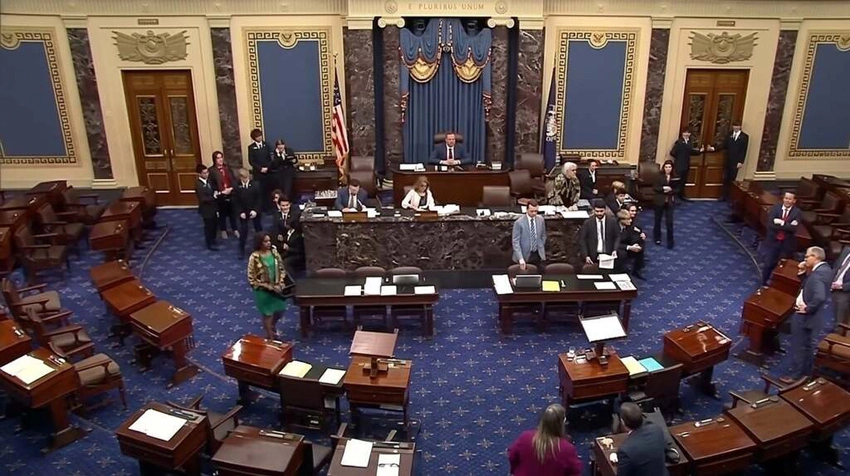
The United States Senate rejected on Tuesday, by a vote of 51 to 47. A Democratic initiative that sought to prevent President Donald Trump from using military force against Cuba without congressional authorization.
The bill, S.J. 124, sponsored by Democratic Senator Tim Kaine of Virginia and his colleagues Ruben Gallego of Arizona and Adam Schiff of California. It is similar to other attempts in recent weeks to challenge Trump’s authority. To lead the United States into war without congressional approval.
The result was narrow and along party lines. Republicans, who control the Senate, voted unanimously against the Democratic proposal. Although Susan Collins of Maine and Rand Paul of Kentucky defected and joined the opposing side.
John Fetterman of Pennsylvania broke ranks among the Democrats, voting with the Republicans.
During Tuesday’s debate, prior to the vote, several members spoke about the inconsistencies in U.S. policy toward Cuba. Called for Cuba’s removal from the list of state sponsors of terrorism. And stated that Cuba poses no threat to U.S. national security.
“The United States has had a long, very long history with Cuba. Which I needn’t recount here. But suffice it to say that, as a member of the Armed Services and Foreign Relations Committees. I have never heard the suggestion that Cuba poses an imminent threat to the security of the United States.” Kaine stated while presenting the draft resolution.
And I believe,” he added, “that it is an accepted fact that there is currently no authorization for war approved by Congress that would authorize military action against Cuba.”
“Therefore, invoking the privileged provision of the War Powers Resolution. I have introduced this along with my colleagues to assert that we should not be at war. That we should not be engaged in hostilities with Cuba. Unless there is debate and a vote in Congress,” he stated.
According to Kaine, under the terms of the resolution. “We are already engaged in hostilities with Cuba, because we are using U.S. force. Primarily the Coast Guard, but also other assets. To participate in a very devastating economic blockade against the island nation.”
“If someone were doing to the United States what we are doing to Cuba. We would definitely consider it an act of war,” he emphasized.
The senator described what the current U.S. coercive measures against the island mean for the Cuban people. Especially the impact of the energy blockade, which from January to March resulted in nearly 100,000 scheduled surgical procedures being canceled in the country’s hospitals. “More than 11,000 of these procedures were scheduled for children,” he noted.
Senator Peter Welch of Vermont, in supporting the resolution to prohibit the unauthorized use of U.S. armed forces in hostilities against Cuba. Raised concerns about President Trump’s statements.
“Our commander-in-chief, and I quote, ‘Cuba is next.’ This is urgent and requires the immediate attention of the United States Senate,” he warned. Also noting that Trump has repeatedly threatened to use force against the island without any legal justification.
No U.S. president, under any circumstances—friendly or otherwise—should threaten to take control of another sovereign nation, Welch emphasized.
For his part, Gallego pointed out that this administration continues to offer nothing but one conflict after another. “Right after New Year’s, Trump illegally invaded Venezuela… less than two months later, he led us into war with Iran. Without any justification or explanation.”
Senator Christopher Van Hollen, a Democrat from Maryland, also supported the resolution. “We have seen deeply alarming rhetoric and actions from the administration regarding Cuba. What began as an economic war has now escalated into open discussions about military intervention,” he emphasized.
“President Trump himself has said, and I quote: ‘Take Cuba. I mean, either liberate it, take it’… But we all know that Cuba is not a property that Donald Trump can acquire.”
Meanwhile, Republican Senator Rick Scott of Florida argued that “President Trump has never suggested that we send troops to Cuba. Therefore, this entire effort is irrelevant,” and in practice—technicalities aside—there was majority support that the United States is not at war with Cuba.
During his speech at a conference in Miami last March, President Trump declared that “Cuba is next.”
The Senate had the opportunity this Tuesday to say “no” to another potentially costly and unnecessary war, but the resolution was killed by Republicans.
With information from Prensa Latina

- Putin states that BRICS has generated over 40 percent of global GDP - 12 de September de 2026
- Between the wind of the tenths and bottled art - 12 de September de 2026
- ETECSA Holguin Hosts Science and Technology Forum - 12 de September de 2026