
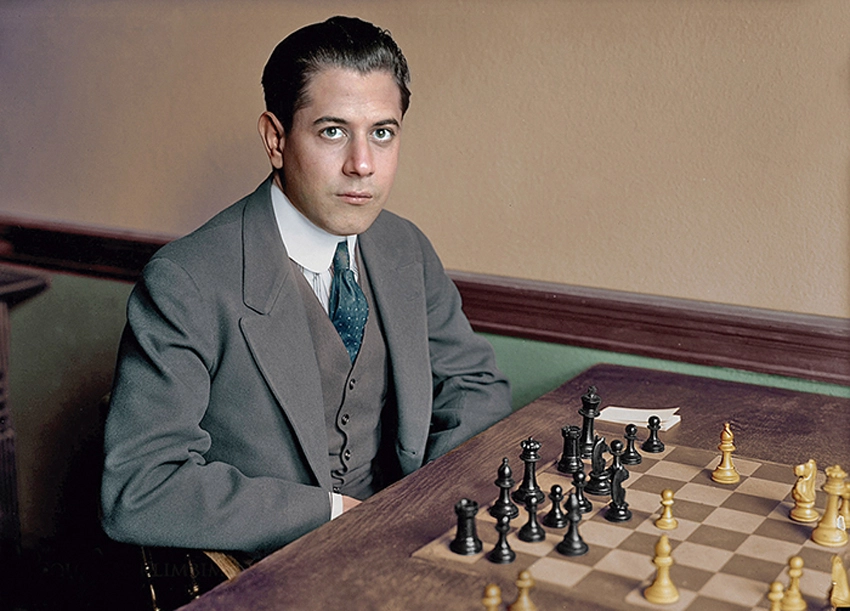
The news of his death, which occurred in the early morning of March 8th, 1942, at Mount Sinai Hospital in New York. Shook the world, but for Cuba it was as if one of its most important pillars had collapsed. José Raúl Capablanca y Graupera had passed away at the age of 53. A victim of a cerebral hemorrhage, and with him went the man who had taught the world that intelligence could also have a Caribbean accent.
But to speak only of his death would be a poor farewell to someone who was. Above all, a symbol of life and genius. He was born in Havana in 1888, and legend has it that he learned to move the pieces at the age of four. Simply by watching his father. There were no manuals or forced studies: chess flowed in him with the naturalness with which others breathe. At 13, he was already the Cuban champion. A title that seemed minor for a boy who would soon begin to astonish the world.
His career was a marvel of consistency. Between 1916 and 1924, at the height of his powers, he maintained an undefeated streak that still amazes historians today. He was a player of dazzling clarity. Also his colleagues called him “the chess machine,” but in reality, his secret was simplicity. He saw the right move, the one that exposed his opponent’s weakness without fanfare. In 1921, in Havana, he dethroned the German Emanuel Lasker. Also who had been world champion for 27 years. All of Cuba rejoiced: a son of the island was the king of intellect in a world that then looked to Europe as the sole cradle of international high culture.
Moreover his reign extended until 1927, when he lost the title to Alexander Alekhine in Buenos Aires. In a match that was always surrounded by controversy and which many attributed to his lack of physical preparation. But Capablanca, far from succumbing to the nostalgia of his lost title, remained Capablanca. He continued winning tournaments, captivating audiences with his style. Demonstrating that a former champion could be just as great as the reigning monarch.
For Cuba, his figure transcended the sporting realm. Capablanca was proof that from the tropics. One could conquer the pinnacle of the game of chess. On a small island, with barely half a century of republican life. His name became a source of national pride. A symbol of what Cuban talent could achieve when it ventured out into the world without inhibitions.
When death surprised him at the Manhattan Chess Club. Watching a game like any other fan, chess lost its most natural player. But his legacy could not be contained in a coffin. His games remained, yes, but so did the indelible mark of a man who, with the simplicity of geniuses, demonstrated that intelligence knows no borders. His body returned to Havana for burial, but his name was already eternal in every corner of the world. Where someone, sitting down at a chessboard, dreams of playing with Capablanca’s clarity.

- Holguin to Host Provincial “Pedagogy 2027” Event - 22 de October de 2026
- UHo Launches Doctoral School as Part of the International CRISS Project - 15 de October de 2026
- New Holguin schoolchildren join the OPJM (+ Photos) - 8 de October de 2026