
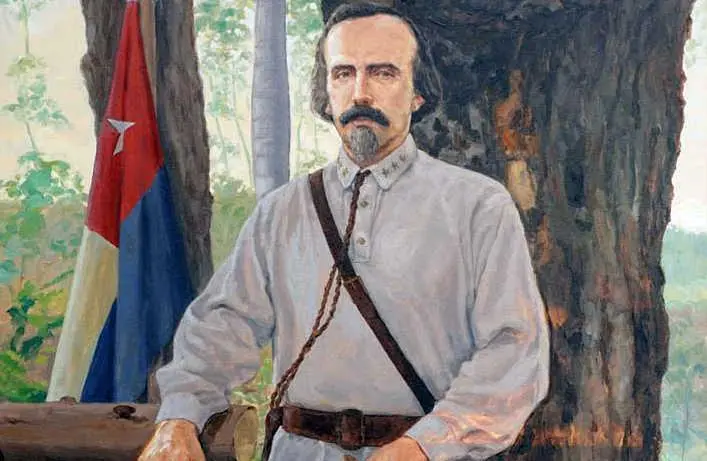
There was a time when Cuba was still a nameless dream. An idea that wandered through the sugar mills, the fields, and the minds of those who read the forbidden philosophers. Until one day, a man with a thick beard and a steely gaze decided it was time for that dream to have a voice. That man was Carlos Manuel de Céspedes, and his story doesn’t begin with an almanac. With a gesture: breaking centuries of silence and summoning a people.
Céspedes was many things in a single life. A lawyer trained in the classrooms of Bayamo and on the roads of Europe. A poet who sang of freedom before writing it with gunpowder. A landowner who looked upon his slaves and understood that the homeland could not be built on chains. When on October 10th, 1868, he gathered a few men at his sugar mill, La Demajagua. And spoke to them of independence. He wasn’t just raising a machete: he was changing history. Before Céspedes, Cuba was a colony. After him, Cuba became a cause.
He organized the first war, drafted manifestos. Served as president of the Republic in Arms, and, against all odds, pushed through the first Cuban Constitution in Guaimaro. He didn’t govern from palaces, but from the bush and encampments. With the sound of war as his constant backdrop. And although politics and disagreements with other patriots removed him from office. They never separated him from the struggle. When he fell in San Lorenzo on February 27th, 1874, it wasn’t a politician or a general who fell. It was a man who preferred to die facing the enemy rather than live on his knees.
Also Céspedes’s legacy isn’t told in textbooks. Even though the books themselves tell of him. He lives on in every Cuban who chooses to stay and build. In every young person who studies to be of service to their land. Also in every farmer who plants a patch of forest hoping to reap a future. He taught us that freedom is not a gift, but a daily conquest. That the homeland is built with hands and soul, and that there is no true independence without justice. His decree abolishing slavery was not just a political measure. It was a declaration of principles that still calls us together.
In today’s Cuba, battered by difficulties that sometimes seem insurmountable, the figure of Céspedes emerges as a necessary reminder. He speaks to us from the distance of centuries and tells us that peoples who forget their origins are left without a compass. He tells us that unity is possible despite differences, that courage is not the exclusive domain of any one era. And that every Cuban, from their own trench—be it a classroom, a workshop, a field, or an office—has something to contribute to this endeavor we call homeland.
That’s why, when the days grow cloudy and discouragement threatens to take hold, it’s worth remembering Céspedes. Not as a statue in a plaza, but as the flesh-and-blood man who one day. At a sugar mill in eastern Cuba, showed us the way. His death in San Lorenzo wasn’t an end, but a passing of the torch. And today, 152 years later, the torch remains lit. Waiting for new hands to carry it.

- New Holguin schoolchildren join the OPJM (+ Photos) - 8 de October de 2026
- Innovating in Cuba: the talent that produces, saves, and solves - 7 de October de 2026
- Cuban Deputy Prime Minister Assesses Water Availability in Holguin - 2 de October de 2026