
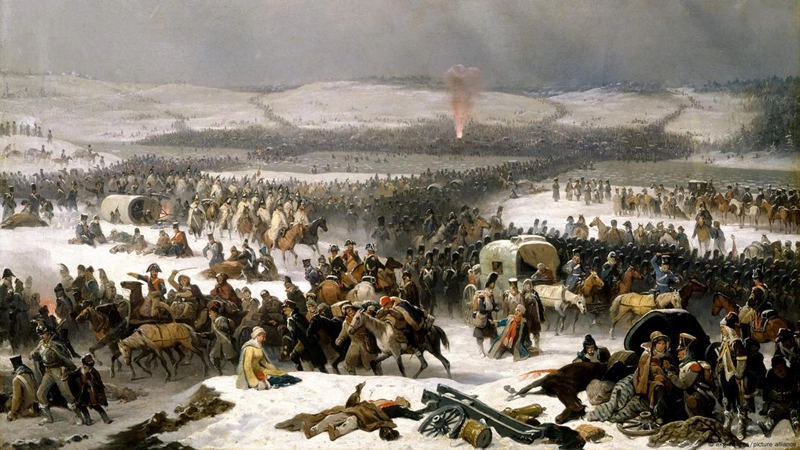
The story of Napoleon’s catastrophic retreat from Russia in 1812 may be being rewritten thanks to advances in genetic analysis. What for decades was interpreted as an episode of mass death caused primarily by typhus and extreme temperatures now reveals a much more complex picture: a diversity of pathogens that decimated hundreds of thousands of soldiers.
The Invasion of Russia: 600,000 Soldiers to Disaster
By the summer of 1812, Napoleon had assembled a formidable multinational army of up to 600,000 troops for his ambitious campaign against Russia. However, the Tsar’s strategy of abandoning Moscow after emptying the city of all supplies forced the French emperor. To begin a desperate retreat toward the Polish border when the harsh Russian winter arrived.
During the months of October through December of that fateful year. At least 300,000 soldiers perished from extreme hunger, freezing temperatures, and a cascade of diseases. That spread relentlessly among the already weakened troops.
Genetic Analysis Reveals New Pathogens
To shed light on what really happened during those nightmarish months, a team of researchers led by Nicolas Rascovan of the Pasteur Institute in Paris and Rémi Barbieri of the Paris Cité University has conducted a groundbreaking study—still undergoing peer review—using cutting-edge DNA analysis techniques.
By examining genetic material extracted from the teeth of 13 Napoleonic soldiers buried in Vilnius, Lithuania. Where numerous troops died during the retreat, scientists have discovered surprising evidence.
Unlike previous studies that pointed to typhus and trench fever as the main causes of death. The new analysis found no traces of Rickettsia prowazekii or Bartonella quintana. The bacteria responsible for these diseases, the scientists explained.
Instead, the team identified the presence of two different pathogens: Salmonella entérica. Which causes paratyphoid fever, and Borrelia recurrentis, which causes louse-borne relapsing fever.
“In light of our results, a reasonable scenario for the deaths of these soldiers would be a combination of fatigue, cold, and various diseases. Including paratyphoid fever and louse-borne relapsing fever.” The researchers note in their report, which has not yet been peer-reviewed.
The difference in findings is primarily due to the methodology employed. While previous research used techniques that amplify specific DNA sequences already suspected of being present. The new study implemented a more advanced metagenomic análisis. Capable of detecting the genetic material of any pathogen present in a sample, making it considerably more comprehensive.
Archaeological details provide additional context to these discoveries. Many of the soldiers were buried in their uniforms and even alongside horses. But without weapons, suggesting that these individuals did not die in combat but rather as victims of diseases, as microbiologist Barbieri explains, according to Science Alert.
Limitations and Future Research
However, some outside experts, such as Sally Wasef of the Queensland University of Technology in Australia, consulted by the scientific journal New Scientist, point out that the recovered microbial DNA was present in low quantities, making “the results more suggestive than conclusive.”
For their part, Barbieri and his team caution that the fact that their analysis did not detect typhus does not mean that this disease did not contribute to the infamous death of soldiers, as they only analyzed samples from 13 individuals.
In this sense, the researchers themselves advocate—and Wasef agrees—for the need to study more soldiers from mass graves. Also where more than 3,000 bodies were discovered in Vilnius in 2001.
Although louse-borne relapsing fever is not necessarily fatal in itself. It could “significantly weaken an already exhausted person,” the researchers explain, creating the perfect conditions for extreme cold and starvation to complete their devastating effect on Napoleonic troops.
This research not only reveals new details about one of the greatest military disasters in history. Also demonstrates the potential of new genetic tools to identify infectious agents in historical populations.
As Wasef suggests, these methods could be applied to study diseases in post-contact populations in the Americas or Australia. Helping to “shed light on the role of disease in past population declines. Particularly where written records are incomplete or biased.”
Edited by Felipe Espinosa Wang with information from bioRxiv, New Scientist, and Science Alert.

- Putin states that BRICS has generated over 40 percent of global GDP - 12 de September de 2026
- Between the wind of the tenths and bottled art - 12 de September de 2026
- ETECSA Holguin Hosts Science and Technology Forum - 12 de September de 2026