
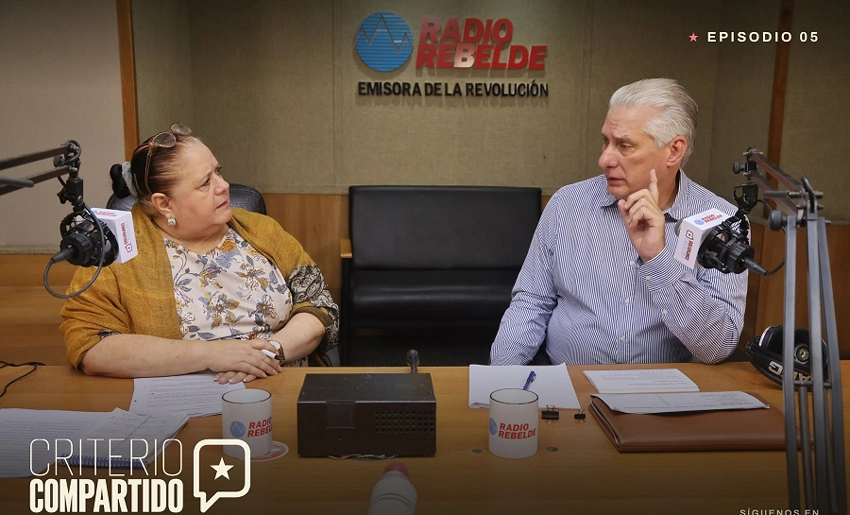
Cuban President Miguel Díaz-Canel dedicated the fifth episode of his regular podcast, *Shared Perspective* (*Criterio Compartido*). To the way institutions should handle complaints, reports, and grievances from the public.
The head of state criticized bureaucracy, insensitivity, and a lack of responsiveness. Announcing that officials responsible for poor service will be held publicly accountable. He further emphasized that listening to citizens is a fundamental obligation of public servants. Warning that this process cannot be limited to merely recording grievances.
“An institution’s primary responsibility is to listen to the people but not stop there. It is about listening, and then organizing, planning, taking action, and monitoring,” Díaz-Canel asserted.
He also acknowledged that a lack of institutional response undermines public trust. Specifically calling out unanswered phone calls, unreplied letters, delays, and the unjustified shifting of responsibilities between different government bodies.
Furthermore, he noted that while economic and material constraints may limit the range of possible solutions. So they cannot be used to justify a lack of initiative, sensitivity, or political will.
During the program, the president provided an update on the follow-up to calls received during the previous episode. The report indicated that water-related issues remain the audience’s top concern, accounting for 18 of the 41 complaints registered.
Other grievances addressed issues related to social vulnerability, housing, and legal matters. “Many solutions did not require large investments, but rather better performance from the institutions,” the president pointed out.
One of the cases examined involved members of the National Association of the Blind in the San Miguel del Padrón municipality. Also who reported difficulties in securing a dedicated space for their organization and accessing social services. In this regard, the president questioned the practice of repeatedly promising solutions over the years without yielding any concrete results.
He also condemned the mistreatment of individuals who file complaints, as well as any retaliation against citizens who seek assistance from public institutions. “This is everyone’s problem, and we must all help to solve it,” he stated.
He further proposed that, in future broadcasts, officials who have failed to fulfill their responsibilities should participate. Publicly explaining their actions and being held accountable before the public.
For her part, First Deputy Minister of Justice Yailet Peña explained the scope of Law 167. The Law on the System for Handling Complaints and Petitions from Individuals which has been in effect since March 13th, 2025.
The regulation establishes a general 30-calendar-day timeframe for processing and responding to complaints. With the possibility of an extension in exceptional cases. When an administrative body fails to meet its obligations, citizens have access to administrative grievance mechanisms and, where appropriate, may turn to the courts.
Peña also reported that, throughout 2026, the Ministry of Justice has overseen approximately 1,500 entities to evaluate their compliance with these provisions.
The program also featured Joel Queipo, First Secretary of the Party in the eastern province of Holguín. Also who shared insights on how the province handles citizen concerns.
He highlighted the “QR Code” initiative, which integrates community meetings, radio broadcasts, the tracking of complaints, and coordination among various institutions.
Queipo explained that suggestions from the public have led to practical solutions. Demonstrating the importance of listening directly to those who are experiencing these problems firsthand.
While the president welcomed the expansion of such initiatives across various provinces, he clarified that the goal is not merely to create radio programs. But to improve the day-to-day functioning of public institutions.
To conclude, the president posed a fundamental question: Why must certain issues reach the president’s desk before anyone takes action to address them? He insisted on distinguishing between difficulties stemming from a scarcity of resources and those caused by administrative shortcomings.
“Also those in lower-level leadership positions should not wait for a problem to reach the country’s top leadership before addressing it,” he stated. He advocated for a culture of public service rooted in responsibility, sensitivity, popular participation, and accountability.
The core message of this fifth broadcast was clear: listening to the people is an obligation. Responding to, managing, and resolving their problems is the benchmark for the effectiveness of institutions.
With information from Prensa Latina

- Libraries and Museums: Time Capsules - 18 de November de 2026
- Shared Perspective: Díaz-Canel Criticizes Bureaucracy, Insensitivity, and Lack of Responsiveness - 18 de November de 2026
- Cuban-Americans Arrested During Protest at U.S. Congress - 18 de November de 2026