
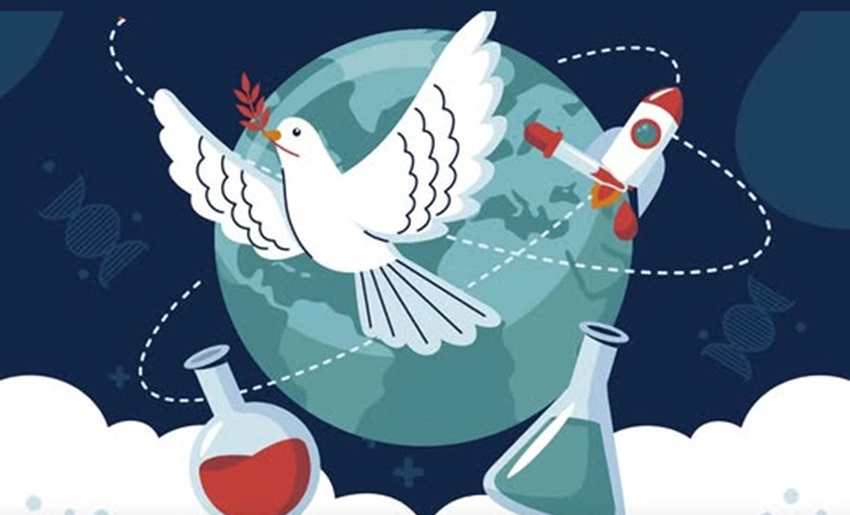
The International Week of Science and Peace invites reflection on knowledge. Who benefits from it, and what responsibilities are borne by those who generate and use it.
Taking place from November 9th to 15th, this initiative serves as a reminder that knowledge can contribute both to the well-being of societies and to the prevention of conflicts.
Also the observance was first held in 1986, during the International Year of Peace. Two years later, in December 1988, the United Nations General Assembly granted it official recognition through Resolution 43/61, which established its annual celebration.
The initiative was founded with a purpose that remains highly relevant today: to promote the exchange of knowledge among researchers from different countries. Also to encourage debate on the relationship between scientific and technological progress, international security, and peace.
A time to bring science closer to society
The observance begins alongside another equally significant event: World Science Day for Peace and Development. Held on November 10th a day proclaimed by UNESCO in 2001. Its goal is to bring scientific activity closer to the general public. Foster interest in research, and serve as a reminder that the results of such work should contribute to improving people’s lives.
Cooperation in research covering areas such as diseases, climate change, biodiversity, natural resource management, and disaster prevention. It demonstrates that certain challenges require shared responses. The exchange of data, experiences, and scientific capabilities enables the discovery of solutions that would be difficult to achieve through isolated efforts alone.
However, scientific knowledge also presents ethical challenges. Advances in artificial intelligence, biotechnology, nuclear energy, and surveillance technologies can offer extraordinary benefits. Yet they may also pose risks if used for destructive purposes or without adequate safeguards. This underscores the importance of ensuring that scientific progress is accompanied by social responsibility, dialogue, and frameworks for international cooperation.
Scientific Diplomacy as a Meeting Point
For 2026, UNESCO has chosen “Meeting Points Through Scientific Diplomacy” as the theme for World Science Day for Peace and Development.
This concept highlights the capacity of research and collaboration among scientific communities to facilitate dialogue,. Build trust, and address issues that transcend national borders.
Scientific diplomacy contributes by creating spaces for cooperation, providing evidence for decision-making, and keeping communication channels open—even in contexts of political tension. In this sense, science can help identify common interests where differences otherwise prevail.
International Science and Peace Week therefore invites us to look at research beyond its discoveries and technological applications. And to reflect on the purpose for which knowledge is produced, who benefits from it, and the responsibilities assumed by those who generate and use it.
In a world marked by war, inequality, and environmental threats, sharing knowledge and strengthening scientific cooperation is not an automatic solution to conflict. However, it is an indispensable tool for building societies that are better informed, more sustainable, and capable of finding collective responses to humanity’s challenges.
With information from Cubasí

- Begins the International Week of Science and Peace - 9 de November de 2026
- “Low-Budget Cinema Factory” Returns for the Gibara Festival - 9 de November de 2026
- Preventive Alert Regarding Electric Scooter Fires in Holguin - 9 de November de 2026