
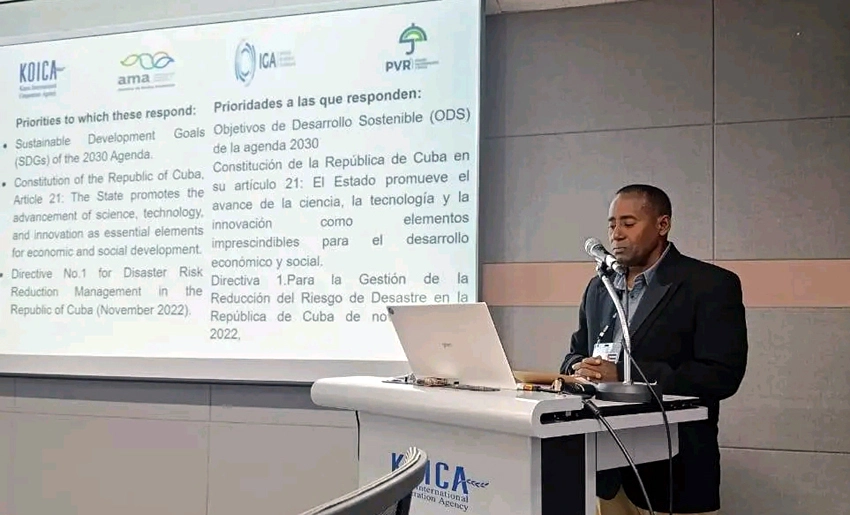
Strengthening community resilience and transforming waste management into an engine of economic sovereignty are strategic priorities for Cuba’s sustainable development. With this premise, a delegation of Cuban government officials, currently training with the Korea International Cooperation Agency (KOICA). Presented an integrated proposal for risk management and climate change adaptation in the Asian nation.
Among the members of the Caribbean delegation is Geovanny Zaldívar Martínez, Deputy Delegate of the Ministry of Science, Technology and Environment (CITMA) in the province of Holguin. The presence of this Holguin official is key to connecting these international experiences. With the strategies already being implemented in the northeastern region. Especially in the management of vulnerable areas and the protection of local ecosystems.
The proposal presented by the Cuban delegation envisions Capacity Building and Knowledge Management Centers as agents of change. These centers are tasked with connecting science with direct action in communities. Strengthening local work so that information translates into lasting solutions to environmental challenges.
Moreover the operational pillars of this approach eliminate the one-way transfer of knowledge and are based on the co-management of knowledge. Through ongoing dialogue among scientists, public administrators, and the population.
Furthermore, the strategy employs a systemic approach that empowers individuals. It strengthens institutions, and refines policies, while decentralizing climate services to the most remote areas. Promoting the use of practical tools such as mobile applications for early warnings.
The exchange with the Korea Environment Corporation (K-ECO) offers significant strategic value. For supporting the implementation of Law 150/2022 on the Environment in Cuba and advancing the “Closed-Loop” policy.
Also the essential objective of the Cuban delegation is not to copy an external model. But to accelerate the learning curve in order to adapt efficient solutions to the country’s material conditions and overcome the limitations imposed by resource scarcity.
Among the technical learning outcomes, the adaptation of regulatory frameworks based on Extended Producer Responsibility stands out. As does the application of low-cost technologies. Such as semi-aerobic sanitary landfills using the Fukuoka methodology. And the promotion of urban mining to recover metals, plastics, and paper.
Added to this is the utilization of agricultural biowaste to generate biogas and organic fertilizers. Along with the strengthening of local governance through performance indicators and digital monitoring tools.
The participation of specialists such as the Holguin sub-delegate of the Ministry of Science, Technology and Environment (CITMA). It consolidates this technical bridge between Cuba and South Korea. This international collaboration demonstrates that shared science is an effective way to mitigate climate vulnerabilities. Alleviate economic pressures on the state, and promote skilled green jobs at the municipal level.
By: Daimy Peña Guillén

- Galo Films and ICAIC Sign Distribution Contract for *Mijaín* Film - 2 de October de 2026
- Cuba Now Has Marine Maps Suitable for Various Applications - 2 de October de 2026
- Experts say the future of tourism rests on sustainability and authenticity - 2 de October de 2026