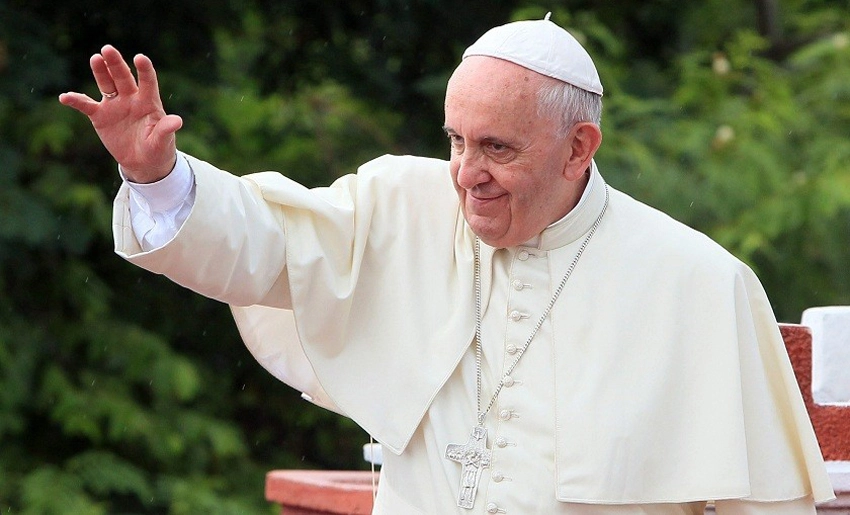
Pope Francis’s visit to Holguin on September 21st, 2015, marked a turning point for this city. Which responded with faith, hope, and an unforgettable civic spirit.
From the early hours of that day, the streets of Holguin filled with people from different parts of the country. The arrival of the Supreme Pontiff represented the culmination of a long-awaited moment.
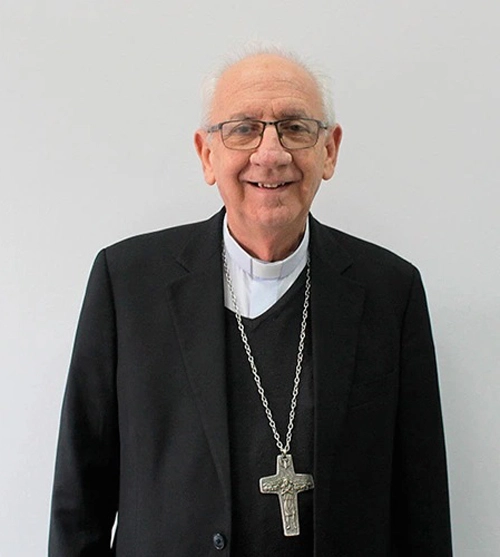
Monsignor Emilio Aranguren, the host of the visit, recalls that occasion with particular emotion: “I was accompanying the Pope, the successor of Peter, but I was also accompanying someone I knew. Someone whose expression I understood. I’ll never forget when we were going to Loma de la Cruz in his panoramic car. And as we turned onto Pepe Torres and Capitán Urbino streets, a man with a child on his shoulders shouted to him, and the Pope greeted him with tremendous spontaneity.”
The Pope’s visit to Holguin was imminent. Religious history demonstrated the need for the Vicar of Christ to come to this region of eastern Cuba.
According to Bishop Aranguren, several events linked to this diocesan territory mark its spiritual identity.
“The first, in 1492 in Bariay, was the arrival of Christopher Columbus in Cuba. The second event, in 1612, was the discovery in Nipe Bay of the floating image of Our Lady of Charity. And there is a third, which has ecclesiastical significance. It was here in this cathedral, on February 1st, 1853, the assassination attempt against Saint Anthony Mary Claret, Archbishop of Santiago de Cuba at that time. These three events mark, so to speak, the religious history of this Diocese.”
Holy Mass was celebrated in Calixto García Revolution Square. Attended by Raúl Castro Ruz in his capacity as President of the Council of State and Ministers. Along with the country’s leading Catholic authorities.
For the occasion, Holguin’s Revolution Square was adorned with a facade designed by architect Ivette Planas. Symbolically evoking the waves of Nipe Bay and the shores of Cayo Bariay. Incorporating key elements of the region’s religious history.
“From an architectural standpoint, and given the square’s design. There was no alternative to create something truly prominent for September 21st, 2015. The challenge was clear: to create a striking setting without detracting from the surroundings. The pressure wasn’t just local or national. We felt an unspoken pressure that we, as the design team, knew existed. That day, the world would have its eyes on Holguin.”
As the architect rightly points out, Holguin was the center of attention in Cuban and foreign media. This required rigorous technological preparation so that thousands of people could witness the apostolic visit live from anywhere in the world.
Germán Santiesteban, a telecommunications engineer at the TeleCristal television station, recalls that “to broadcast the route. A helicopter was used with one camera to capture aerial images and another from a car traveling ahead of the Pope. To achieve this, it was necessary, among other things, to construct fiber optic links between these fixed points and the ETECSA center located at TeleCristal. It was also necessary to establish the links that allowed the signal to be relayed to the helicopter and from there sent to the tower on Loma de la Cruz. From where it was sent to Havana and broadcast via the national network.”
For the journalists, the coverage was a challenge. Abdiel Bermúdez, one of the reporters who experienced it, describes it as one of the most memorable of his career.
“When people ask me which of my journalistic assignments have left the biggest mark on me, I always mention covering the Pope’s visit to Holguin. For any kind of journalistic coverage, you prepare extensively. I was fortunate to have the support of Bishop Emilio Aranguren himself. I believe that was also part of that preparation. That way of crafting a message that connects with the feelings and faith of the people.”
Every resident of Holguin has a memory of that visit. Which marked a turning point in the history of Holguin. This is what Bishop Emilio Aranguren of the Diocese of Holguin affirms.
“As history often says, before Christ and after Christ. Pope Francis’s visit to our Diocese has also left its mark. Specifically, the outreach and the opportunities provided for members of the most remote communities to participate in the celebration speak volumes.” Today people say: “When the Pope visited, I was one of those who went. So that definitely marks a positive element.”
For Abdiel, it also marks a special chapter in his life: “I think it was a very special event for everyone in Holguin. It certainly was for me. Since then, I consider myself a Holguin native who isn’t Catholic, but who believes.”
The mark Pope Francis left on Holguin transcends the passage of time. This wasn’t just the visit of another head of state, but the presence of a messenger of peace who opened paths of hope and unity.
His embrace of faith and mercy remains alive in every corner of this city. Reminding us that greatness lies in the simplicity and heart of its people.
By: Miguel David Bruzón Hernández

- Martín Arranz: From Opera Singing to Tango and Radio - 26 de July de 2026
- Díaz-Canel Led Swearing-In Ceremony for New Ambassadors - 25 de July de 2026
- Alberto Juantorena, Centennial Athlete of the Central American and Caribbean Sports Games - 25 de July de 2026