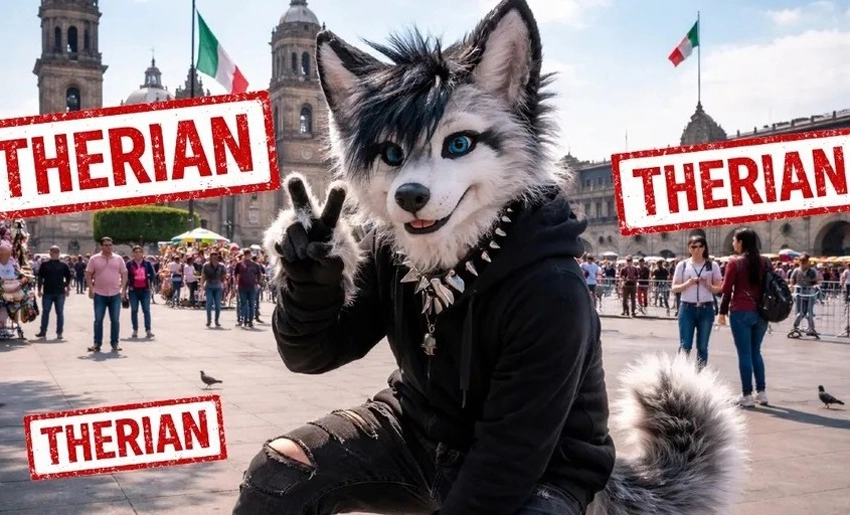
These are frequently discussed today. They originated in online forums in the 1990s, now go viral on social media. And have recently begun appearing in public spaces (squares, parks, and schools, among others). It’s very common to find them on Instagram, Facebook, YouTube, and TikTok because they have become a trend. They are mostly teenagers and young adults who claim to identify with non-human animals. Which has sparked curiosity and considerable controversy.
The question of the limits of human identity has occupied philosophy, anthropology, and psychology for centuries. However, in the last two decades, an identity phenomenon has emerged in the Western world. That uniquely challenges conventional categories of subjectivity: theriotropy.
What for many seems like just a strange fad is for others a way of expressing who they are: they identify as “therians.” People who feel a spiritual or psychological connection with a specific animal.
Social media is overflowing with news stories, memes, and reels featuring young people “dressed up” as animals—therians. A movement of people who partially or completely identify as non-human animals. They run on all fours, make sounds (growling, barking, ruminating), wear masks of dogs, cats, tigers, lions, and even seals. And record themselves jumping and behaving like the animal they identify with.
The term comes from the English word “therianthropy,” which in turn derives from the ancient Greek words “therion” (meaning beast or wild animal) and “anthropos” (human). It refers to the spiritual ability to transform into an animal, but this transformation is not physical. Those who identify as therians understand that they have a human body, but they may feel that their soul belongs to an animal. Or that they maintain a deep affinity with a particular species.
Also these young people assert that their experience is not a voluntary decision, a game, or a disguise. So rather that their spirit has simply surfaced, revealing their non-human identity. They affirm that it is not a fad or a social media trend. Quite the contrary, it is something lasting because it is fundamentally their identity. As they explain in their own guides to therianthropy. It is an identity they proudly display and reinforce in their virtual and in-person encounters.
Historical Background: From Hidden Subculture to Viral Phenomenon
Beliefs related to hybrids (human-animal) have existed since antiquity, present in mythologies and legends such as lycanthropy (the werewolf). However, the therian identity as a contemporary community emerged in the 1990s in internet forums. Where spaces for discussion about these experiences began to be organized, but its leap to popularity came with the rise of social media.
For years, the therian community was a small group that moved in very specific corners of the internet, or private forums. There they discussed experiences, coined terms, and built an internal language and ways of interacting. With the arrival of platforms like Tumblr and TikTok, that conversation ceased to be invisible and became public, easily shareable and replicable.
In Latin America, the movement has gained momentum, especially in countries like Argentina and Uruguay. Also where videos of young people barking, meowing, or wearing fake ears and tails have gone viral, sparking intense social debate. This digital wave, amplified by memes, reactions, and news coverage, has spread to Mexico and other countries in the region. In-person gatherings are also beginning to be organized in plazas, universities, and parks.
Psychologists and psychiatrists do not classify this movement as a mental disorder and maintain that it does not require professional intervention. As long as it does not affect functionality or cause significant suffering.
It should be noted that science recognizes a psychiatric phenomenon classified as “rare,” clinical therianthropy. Which is the delusional belief of a person that they can transform into an animal or become one. This is pathological and has diagnostic implications, but it is not directly related to this community. The therians we see on social media are fully aware that they are human and lead relatively normal lives. With stable family, social, academic, and professional lives.
As with other youth identities and subcultures, the story of the therians continues to unfold in real time, at the speed of social media. What is perceived today as a fad could, in some cases, remain a passing phase. In others, it will become a permanent part of the lives of those who identify as part of this community.
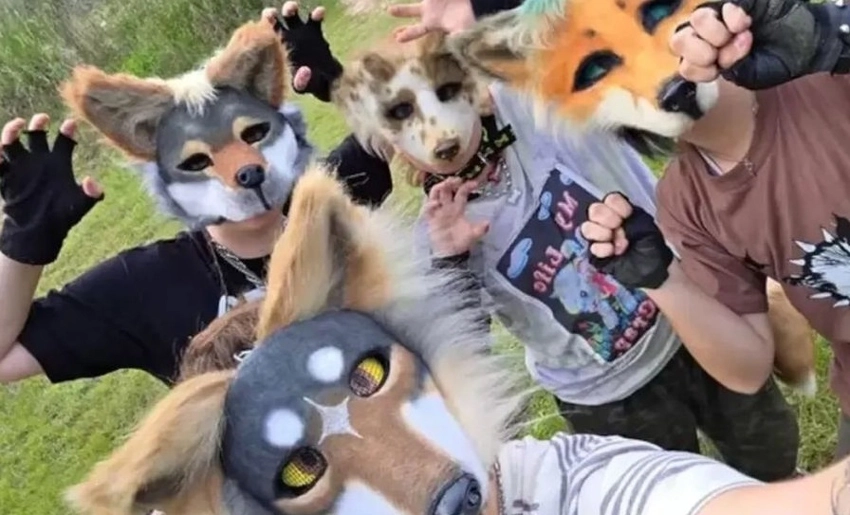
Meanwhile, the challenge for families, schools, and professionals is twofold: to listen to young people without immediately dismissing their way of identifying themselves. At the same time to offer clear frameworks regarding well-being, boundaries, and coexistence. Amid barking, jumping, and animal masks, what is at stake is not just a viral trend. So new ways in which younger generations are rehearsing to define who they are in a world that can no longer be understood without the internet.
Are there therians in Cuba?
In our country, the phenomenon hasn’t yet reached a massive scale, but there are already visible signs that the trend has crossed digital borders. One of the most notable cases is that of a Cuban stylist known on Instagram as ‘Leuryz Salon’. The hairdresser recounted in a video that a young woman requested a specific haircut that was an aesthetic adaptation consistent with her fox identity.
According to the professional, the client explained that she considered herself a therian and identified with a “vulpes” (common fox or red fox). The initial reaction was surprise, but she ultimately offered her services. The video went viral and generated hundreds of comments.
Shortly after, another testimony began circulating, this time from a young woman living in Havana who openly presents herself as a “therian seal.” In a video she recorded herself. She states that due to the country’s economic situation, she cannot afford accessories like masks or synthetic fur, but that this does not affect her identity. She even imitates the animal’s sounds in front of the camera.
These are isolated cases, but they demonstrate that the topic is no longer hypothetical in Cuba. Access to mobile internet, although expensive and limited. It has allowed global trends to quickly take hold among young people.
It seems worth noting that there is currently no official data or academic study confirming the existence of organized therian communities on the island. Nor are there any records of in-person meetings or well-structured movements. Therefore, up to this point, everything points to individual expressions that replicate a global trend.
Some defend individual freedom of expression. Others see it as an exaggerated manifestation driven by algorithms and virality. There are also those who interpret the phenomenon as part of a search for identity and belonging in times of uncertainty.
Finally, theriotropy calls us to reflect rigorously and clearly on the philosophical, scientific, and psychological foundations of human identity. The question of what it means to be human, whether humanity is a biological essence or a culturally constructed category. Also with how the self is constituted in relation to its limits. Including the limits of the species, is far from trivial. Therianthropes remind us of the scope of the self as a lived experience. That this experience can take forms that confront the limits of the rationality upon which culture is founded and sustained.

- The Therian Phenomenon: Human Body, Animal Soul - 11 de March de 2026
- Six Techniques for Regulating Your Emotions - 4 de March de 2026
- Muscle dysmorphia: the obsession with body perfection - 2 de March de 2026