
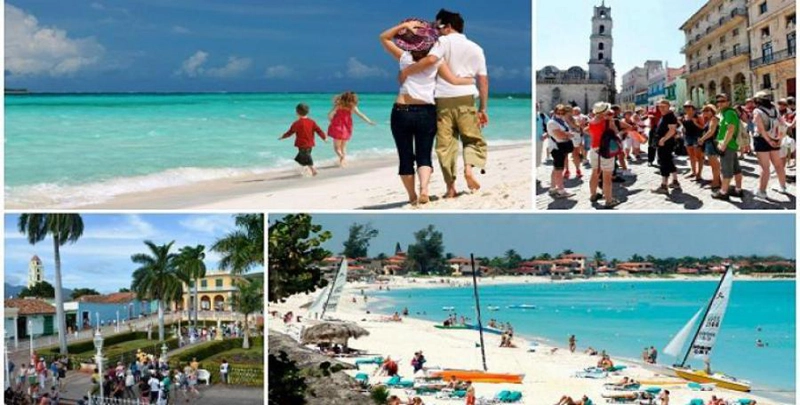
For some analysts, beyond statistics and graphs of income and travelers. Tourism is measured by the beauty of the landscape, attractions, charm, people, and traditions—elements very much present in Cuba today.
The Cuban archipelago, for one reason or another, is always in the news, and even more so in the area of tourism. Options include nature, adventure and rural tourism, historical tours, delving into traditions. Despite food shortages, exploring recipes that have been passed down through families.
Seeking a balance of information and analysis, 2025 is shaping up to be a period of moderate but tangible recovery for Cuba.
Also the travel industry remains vital to its economy. After failing to reach its most ambitious goals in 2024, the focus is on consolidating its offerings. Addressing its chronic structural challenges to capture a larger share of the global market.
As a year-end projection for international arrivals. It appears that between 2.2 and 2.8 million foreign visitors will arrive in Cuba.
This figure would represent significant growth compared to 2023-2024. Although it falls short of the more than four million who arrived before the Covid-19 pandemic and the intensification of coercive measures by the United States.
Furthermore, Washington’s barriers against Havana. In place for over 60 years, remain unchanged in terms of financial, commercial, and economic systems.
Regarding source markets, diversification continues, with Canada leading the way. In fact, Tourism Minister Juan Carlos García recently stated during a visit to Canada that the conditions are in place for more than one million visitors from Canada to arrive in Cuba next year.
Cubans, primarily those living in the United States, who travel through the U.S. government with travel permits, are the second largest source of visitors. A recovery is observed in the number of European visitors arriving via direct flights from Spain, France, Germany, and the United Kingdom. Tourism from the United States (excluding Cuban-Americans) remains a small and volatile segment. Subject to the evolving political climate between the two nations.
However, Cuba’s challenges lie in a strategy that encompasses even new types of travelers. Increasingly seeking authenticity and culture. There is growth in the nature tourism, hiking, and specialized cultural tourism segments. With highly attractive destinations such as Viñales National Park, Topes de Collantes, and vacations focused on music, art, and architecture.
In this last area, Cuba boasts a unique and undiminished cultural offering. As the authenticity of its World Heritage cities (Havana, Trinidad, Cienfuegos), its live music, and its vibrant culture continue to be a powerful draw.
Analysts are therefore returning to the topic of the potential for nature and sustainable tourism. Given the country’s exceptional biodiversity and well-preserved landscapes. One of the sector’s main strengths is its sun and beach tourism producto. With destinations like Varadero, Cayo Coco, Guardalavaca and Cayo Largo del Sur maintaining their competitiveness. Thanks to the quality of their beaches and the excellent value for money offered by their all-inclusive resorts. Which are particularly appealing to the Canadian and European markets.
Added to these strengths is the development of non-state infrastructure: the growth of private businesses (restaurants known as paladares, private homes, and hostels) enriches the gastronomic and accommodation options.
Despite these possibilities and probabilities, a number of challenges and disadvantages exist. Primarily infrastructure and connectivity, with persistent chronic transportation problems, intermittent electricity supply, and poor internet connectivity.
Furthermore, air accessibility and costs remain problematic. Although the availability of international flights is improving, the network has not yet recovered completely. Also the costs of flights and tour packages can be high compared to other Caribbean destinations.
Of course, it’s essential to consider the complex internal economic situation. Particularly the financial one (with the circulation of the Cuban peso and the MLC, or the dollar via credit cards). This creates supply difficulties and affects the availability and variety of products in hotels and restaurants.
Moreover this is a point that the authorities have addressed on several occasions. To resolve it, they establish contracts with suppliers and distributors in order to confront the shortage of food and other essential supplies for the hotel industry.
Adding to these challenges is regional competition from destinations like the Dominican Republic, Mexico, and Jamaica. Which tend to have more developed infrastructure and good marketing strategies.
Potential as a Weapon
The year 2026 presents a crucial opportunity for Cuba if it manages to address its weaknesses.
Hence, experts insist on investment in critical infrastructure. The expected arrival of more foreign investment. Especially in the energy and hotel sectors, could begin to show tangible results and improve the reliability of services.
Another aspect would be positioning itself as a Slow Travel and wellness destination. Due to its potential to attract travelers interested in a partial digital disconnection, authentic well-being, and connection with the local community, coupled with meetings and conference tourism.
Another detail hanging like a sword of Damocles over Cuban tourism is the easing of relations with the United States.
For some scholars, any gesture of political détente would have an immediate and positive impact. Facilitating travel for US citizens and opening up the world’s largest source market. Something that, for the moment, does not seem likely given the constant pressure from Washington. Finally, it would be appropriate to consider the potential of cruise tourism. Because a full recovery of this market and the modernization of its ports could transform Cuba into a key hub for Caribbean itineraries.
By 2025, Cuba will no longer be the mass tourism destination of yesteryear. But rather one reinventing itself for a more discerning traveler. Its medium-term success will depend on its ability to enhance the on-the-ground experience. Through strategic investments and navigate the complex geopolitical landscape to attract more visitors.
Official data on tourism in Cuba highlights the existence of approximately 84,000 hotel rooms, 10 international airports, and an equal number of marinas, with three cruise terminals.
Furthermore, 19 foreign hotel chains from 10 countries operate in this archipelago. Managing 57,291 rooms across 153 properties. Spain leads the way with Meliá Hotels International. Which manages 36 establishments, and Iberostar is also a significant player.
In conclusion this tourism infrastructure is constantly growing. Supported by a rich cultural, architectural, and natural heritage. Including nine sites declared World Heritage Sites by the United Nations Educational, Scientific and Cultural Organization (UNESCO).
In addition, there are six Biosphere Reserves, 17 National Cultural Heritage sites, five Intangible Cultural Heritage sites, 227 National Monuments, six Ramsar Sites (Wetlands), and 14 National Parks. All of this enriches the potential for tourism recovery.
With information from Roberto F. Campos/Economics Desk/Prensa Latina

- The National Electric System is connected from Pinar del Rio to Holguin - 17 de March de 2026
- Cuban Civil Defense General Staff Denies Alleged Official Statement on “Zero Option” - 16 de March de 2026
- Pexac Holguin Workshop Ensures Equipment Functionality - 14 de March de 2026