
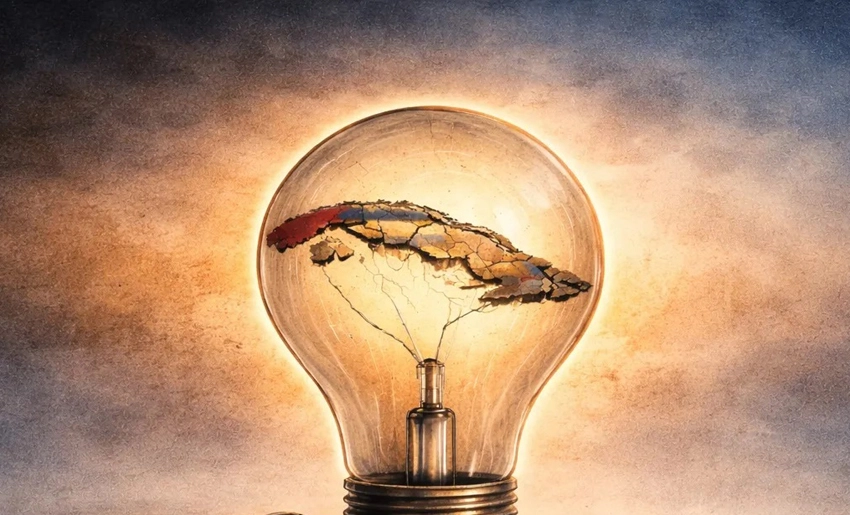
The energy crisis in Cuba has a face that goes beyond the blackout. It hides in the refrigerator that is no longer a refrigerator, in the harvest that is lost due to lack of irrigation. In the price of chicken that rises a thousand pesos from one day to the next. Cuba rightly denounces the blockade and the thermal crisis. But there is an edge that hurts with equal force: the contradiction of asking for local food production. While the lack of electricity and fuel suffocates, precisely, that production.
The economic data is cold. The investment is concentrated in solar parks and the electroenergy system. Holguín, with the contribution to the National Electroenergy System mainly through the Lidio Ramón Pérez Thermoelectric Power Plant, in Felton. Whose units have reported variable contributions depending on their technical state. With figures of 130 MW in a stable reconnection and 200 MW in other synchronizations. It becomes a pillar for generation in the eastern region.
Added to this are the photovoltaic solar parks, which until January 2026 totaled 87.5 MW synchronized—close to 18% of provincial consumption. With projects under development such as Serones 3 in Cueto (21.8 MW), La Caridad in Rafael Freyre (21.8 MW) and Loma del Cedro (10 MW). Aimed at increasing the contribution to the 109 MW planned for the end of 2025. So that Felton remains the largest and most consistent source of power as solar generation grows rapidly to diversify the province’s energy mix.
It’s a real effort. However, domestic life and food production do not wait for the energy matrix to change. Despite efforts, blackouts can exceed 20 hours. When the light goes out, so does the possibility of preserving milk, eggs, and meat. Families buy for the day, not for the week. And the expense multiplies.
The “suffocation” that does not distinguish between the stove and the furrow
There is the first contradiction. The government calls for local production to replace imports. But the local producer, the same one who receives land in usufruct and sows, faces a wall: without electricity there is no pumping of water to irrigate.
Moreover the lack of generation affects the irrigation systems that are electric and causes a drop in productive yields of up to 30% compared to 2025. The cold storage rooms on the farms are turned off, and the crops decline. Local production is not just a slogan. It is water, cold and fuel. And today all three things are missing.
According to the National Bureau of Statistics and Information, 773,430 tonnes of vegetables were produced in 2024, 30% less than in 2023 and almost half that in 2022. Rice production fell to 79,000 tonnes in 2025, down from 304,000 in 2018. It’s not just the blockade. It is also that the electrical system does not support irrigation, nor refrigeration, nor transportation that takes the furrow to the plate.
President Díaz-Canel has said it: the crisis has “a single cause: the genocidal energy blockade.” And it is true that the blockade suffocates. But a critical analysis cannot stop there. External asphyxiation intersects with an internal vulnerability that the energy crisis mercilessly exposes. A system that prioritizes generation for urban consumption and leaves food production competing for the same scarce energy.
Investment in solar parks is necessary. But while the panels are installed, the country eats what it can cool. And what it can cool depends on the light that does not reach it. The contradiction is not rhetorical, it is economic and social. Asking for local production without guaranteeing energy to irrigate. To conserve and transport is asking the producer to solve with his hands what the system does not deliver.
The social cost of this “suffocation” is not measured only in megawatts not generated. It is measured in the fair that runs out of supply, in the juice that cannot be bottled. In the worker who loses her job in a rural mini-industry. It is measured, above all, in the growing distance between what is declared as a priority and what reality allows us to do. The criticism is not of the investment effort. It is logical that, while building the energy future, it lets the productive present fade away.
By: Daimy Peña Guillén

- Energy crisis: suffocation beyond the blackout - 27 de November de 2026
- Holguín Faces a Dilemma: Revitalize Premises or Neglect the Vital Functions of Pharmacies? - 27 de November de 2026
- Cuba Secures Spot in U-12 Baseball World Cup - 27 de November de 2026