
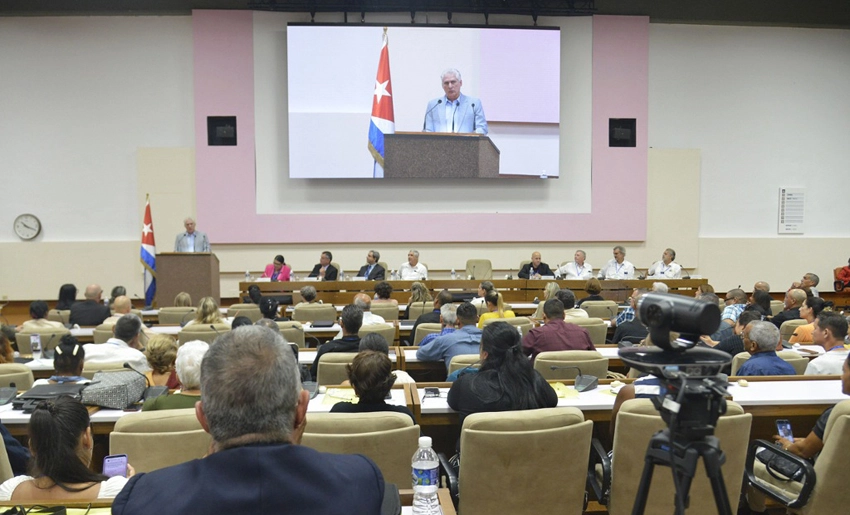
Cuban President Miguel Díaz-Canel today urged a transformation of management methods. At the municipal level to implement the 176 economic and social transformations being carried out in the country. In his closing remarks at the International Congress on Management and Local Development, Tourism, and Cooperativism (CE-GESTA 2026). The president stated that centralized management and promotional coordination are insufficient.
The key, he emphasized, is achieving effective operational implementation at the territorial and community levels. A task already being promoted by the municipalities.
The head of state stressed that each territory requires well-prepared managers, dynamic cooperatives, comprehensive tourism, applied innovation, and a network connecting it to the outside world.
Díaz-Canel emphasized that CE-GESTA 2026 was an exercise in collective reflection on issues at the heart of current changes. While also highlighting the opportunities presented by economic and social transformations in the face of maximum economic strangulation by the United States.
In summarizing the Congress’s debates, the president identified five fundamental pillars. Beginning with the role of leadership as a common factor in moving from theoretical research to practical transformation.
He explained that the measures grant an unprecedented degree of autonomy. Although he cautioned that this autonomy is only meaningful if the leader acts as a driver of change and not as a passive executor.
As a second pillar, he highlighted local development, noting that municipal autonomy makes this jurisdiction the basic unit of economic development. With real powers for strategic planning, land-use planning, price and foreign exchange management, and the defense of food sovereignty.
The third focus is on local tourism as an engine of foreign exchange and employment. An area that requires investigating the relationship between state-run tourism, private accommodations, and service cooperatives, along with the local production system.
Fourthly, he mentioned cooperativism, whose true innovation lies in internal democratic management as a specific form of popular control.
While the fifth focus encompasses innovation, the energy transition, and digital transformation, considered essential conditions for progress.
He also highlighted the 20th anniversary of the National Network for University Management of Knowledge and Innovation for Local Development. Created to transform universities into key players in territorial progress.
Díaz-Canel, who received recognition for his contribution as a driving force behind this initiative. Emphasized that the university-territory link bears fruit when there is institutional will and shared methodologies.
In a context of blockade and energy embargo, the network has demonstrated that applied science and collective intelligence prevent research from coming to a standstill. “Every classroom, every diploma program, every project is an act of cognitive sovereignty,” he noted.
With information from Prensa Latina

- Díaz-Canel Urges Transformation of Management for Development at the Closing of CE-GESTA 2026 - 13 de November de 2026
- European Film Festival Opens in Holguin with Film on Inclusion - 13 de November de 2026
- Operetta Returns to the Rodrigo Prats Theater with Three Classics from the Lyric Repertoire - 13 de November de 2026