
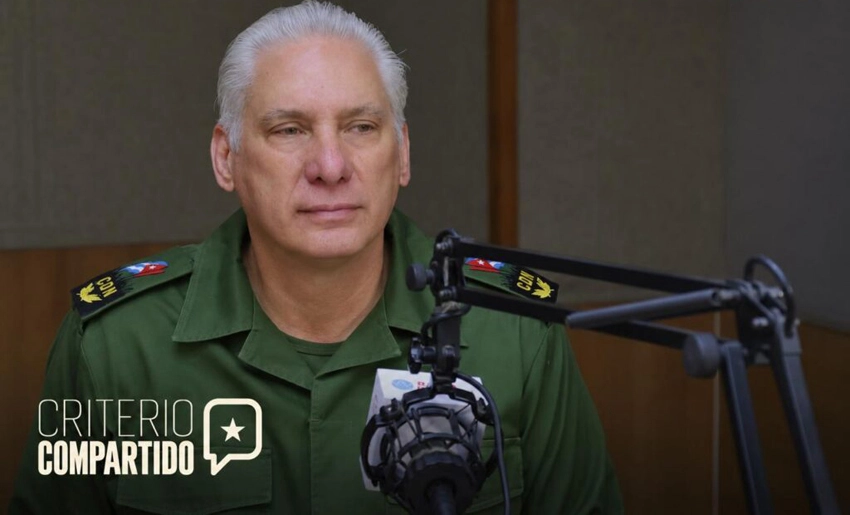
Cuban President Miguel Díaz-Canel called today for a self-critical approach to the country’s water supply situation. Distinguishing between external and internal challenges and demanded that institutions fulfill their social responsibilities.
Water is one of the nation’s most sensitive issues. While there are objective causes. Such as the blockade, the energy crisis, and aging infrastructure. There is also a prevalence of negligence, apathy, and a lack of coordination, the president stated on the radio program *Shared Criterion*.
The former, he noted, must be addressed through investments and a comprehensive program—even amidst the current complex situation. While incorporating oversight and public participation. The latter must be tackled through strict accountability, oversight, and a high degree of responsiveness.
After hearing from citizens who reported going months or even years—without piped water and without receiving timely responses. The head of state warned that when an official fails to respond, it is not a matter of the blockade. But rather an institutional responsibility that must be enforced.
The president explained that prolonged water shortages stem from the deterioration of a network that has lacked necessary maintenance for years. When this is compounded by the blockade, electricity shortages, and management deficiencies, the result is a systemic failure. Both in terms of infrastructure and institutional management.
“We must distinguish between what needs to be addressed through material means. Such as investments and infrastructure and the purely institutional aspect. Which entails listening to the public, providing explanations, and offering solutions,” he emphasized.
In his view, the problem is multifactorial and requires comprehensive solutions. Consequently, the country is implementing a program built on three fundamental pillars. The restoration of water supply sources, the energy transition, and the strengthening of institutional management. With a consistent focus on addressing the needs of the population.
The president stated that the crisis represents an opportunity to move forward. Not only by resolving immediate problems but also by addressing long-standing, accumulated issues. He emphasized the importance of listening to the people, visiting them, instilling confidence, seeking solutions, and fully embracing the role of public servants.
Referring to the specific case of a Havana resident who had gone more than six months without receiving a clear response regarding water shortages in her community. Also the president stressed that “six months without an answer is an institutional failure.” Adding that “six months of silence cannot be justified by any technical complexity.”
He further emphasized that no government entity should take so long to address a complaint.
The president highlighted other priority areas for alleviating the current situation and public discontent. Such as taking action against individuals who divert water resources for their own private gain. Ensuring reliable service to gradually reduce dependence on water tanker trucks.
He also called for continuous follow-up on all concerns raised by citizens, not just those that gain media attention by being brought up during the broadcast.
For his part, Antonio Rodríguez, president of the National Institute of Water Resources, noted that Havana is the city most affected by water scarcity in the country, with more than half a million users impacted.
Efforts are underway in the capital to reverse this situation by transforming the energy matrix. Key projects include the construction of 10 solar photovoltaic parks (with a 200 MW capacity, including energy storage). To support the city’s three primary water sources: Cuenca Sur, Ariguanabo, and El Gato.
He noted that these projects are currently underway, with a projected completion date of August next year. Though an extraordinary effort is being made to finish them sooner.
Additionally, work is being carried out at the main water supply sources to ensure their continued operation through the installation of power generators. Of the 11 existing water sources, 8 already have backup systems, and work is underway on the remaining three.
In the other provinces, Rodríguez noted, 866 of the 1,312 required pumping units have been received, with 853 currently in operation. The remaining units are expected to arrive before the end of this year. He therefore emphasized the importance of expediting the distribution and installation processes.
With information from Prensa Latina

- Educator from Holguin Receives Honorary Doctorate at World Education Summit - 5 de November de 2026
- Díaz-Canel Urges Improvement in Institutional Management of Water Supply - 5 de November de 2026
- Midterm Elections: A Rebuke to Trump - 4 de November de 2026