
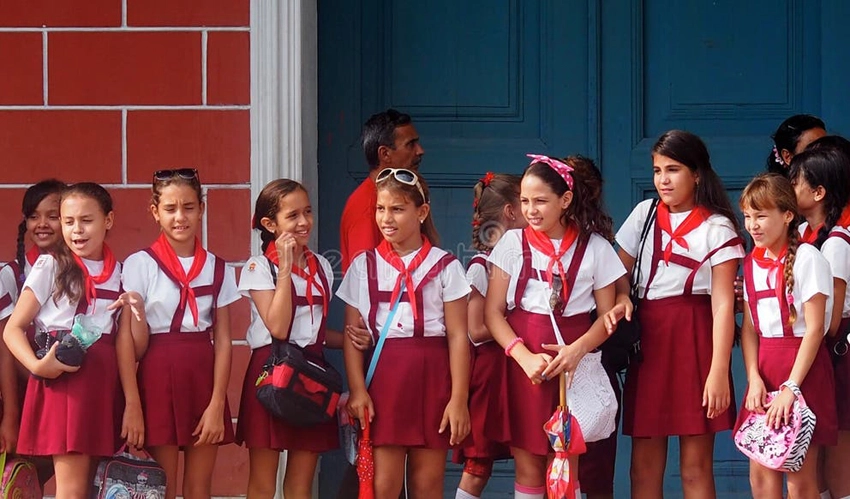
For decades, the use of school uniforms has been one of the symbolic pillars of education in Cuba. Originally conceived as a tool to create equity and parity among students. Erasing differences of class, origin, or economic means. The uniform also functioned as an emblem of identity, respect, and belonging to the educational community.
However, today, this homogeneous and disciplined image has fractured, at least in the province of Holguin. Also where the daily reality in schools reveals a profound and, for many, worrisome transformation.
The starting point cannot be ignored: national uniform production fails to meet the total demand from students. Entire families scour informal markets, workshops, and even social media to find a garment that approximates the official model, when they don’t opt to make them themselves.
Also this structural deficiency has unintentionally opened the door to an erosion of school dress codes. However, the issue goes beyond mere scarcity. Anyone visiting any secondary or pre-university school in Holguin today will encounter an aesthetic landscape. That contrasts sharply with what was established just seven or eight years ago.
Girls have shortened their skirts to extremes that have nothing to do with modesty or practicality. Often sporting blouses with plunging necklines, outside the official design. Paired with shoes that evoke a party or an afternoon at a nightclub more than a classroom. Excessive makeup—eyeshadow, eyeliner, and brightly colored lipsticks. So it completes an image that seems to defy any notion of uniformity.
In the case of boys, the transformation is equally striking. Long hair, earrings, and piercings. Elements that until less than a decade ago were incompatible with the image of the Cuban student—are now commonplace.
There is no visible control, nor a systematic application of disciplinary measures. Which suggests an institutional tolerance that could well be interpreted as resignation or as an express democratization of the rules.
Moreover the debate is significant because the uniform is not just clothing for going to school. It is, or should be, a symbol of identity and respect for the institution. When that boundary is blurred, the school loses part of its symbolic authority.
Instead of feeling part of an egalitarian group, students project their most extreme individualities. Which ends up subverting the primary function that justifies the uniform: equity.
When clothing and personal adornment become a field of aesthetic competition or silent rebellion. The student with fewer resources is once again exposed, and the parity envisioned by the Revolution vanishes.
The rhetorical question in the face of this complex situation is: are we witnessing an organic phenomenon of cultural change, an unforeseen consequence of material shortages, or simply the abandonment of a rule that no one dares to enforce anymore? Probably a bit of everything. The truth is that to look at a school in Cuba today and claim that school uniforms are respected would be to deny the obvious.
The current picture reveals, rather, a youth exploring their own identities in the only space where they can still do so. Also an institution that has gradually relinquished, without debate or a clear strategy, one of the most visible symbols of its egalitarian educational project. Equity, when the common code is diluted, ends up falling victim to unchecked creativity and a lack of control.
By: Daimy Peña Guillén

- Putin states that BRICS has generated over 40 percent of global GDP - 12 de September de 2026
- Between the wind of the tenths and bottled art - 12 de September de 2026
- ETECSA Holguin Hosts Science and Technology Forum - 12 de September de 2026