
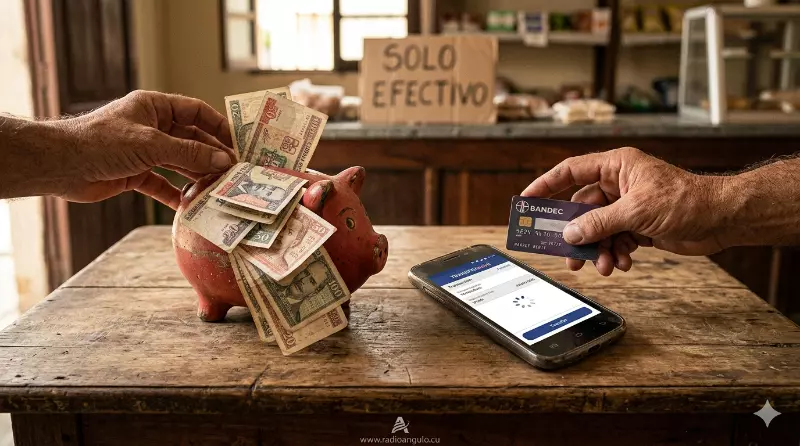
The transition to a digital economy is, in theory, a sign of progress. In any modern context, banking promises transparency, speed, and security. However, in Cuba’s current scenario, the implementation of mandatory transfers has become a head-on collision. Also between institutional will and the economic survival of ordinary people.
The Financial Bermuda Triangle
The problem can be summarized as a vicious cycle that is suffocating the consumer. On the one hand, the State has migrated salary and pension payments to the electronic sphere. On the other, the non-state sector—which today sustains a vital part of the supply of basic goods—is resisting accepting these digital payments.
Is this resistance a mere whim of the self-employed? Hardly. The reality is that the Cuban economic ecosystem today suffers from a “cash shortage” and a lack of real convertibility through official channels. For entrepreneurs, accepting a transfer into a tax account often means “freezing” their working capital:
Withdrawal difficulties: Cash limits and ATM queues prevent the quick conversion of digital money into physical currency.
Logistical shortages: Many wholesale or informal suppliers require cash to restock merchandise. If the merchant doesn’t have banknotes, there are no products on the shelf.
Penalties vs. Solutions
Faced with this resistance, the response has been control and penalties for tax evasion. Or the use of personal accounts instead of tax accounts. While tax regulations are necessary for any nation. Applying the law punitively without addressing the structural causes of the rejection of digital payments is like trying to put out a fire with gasoline.
When a business is fined or closed for not accepting transfers, it is the public that “pays the price.” Citizens find themselves with a card full of credit, but an empty table, because the place where they could buy food is no longer operating or prefers not to sell to avoid breaking the law.
A Transition Without Foundations
Economic inclusion requires three pillars that are currently faltering on the island: stable connectivity, trust in the banking system, and cash availability. A first-world digital economy cannot be demanded. Also when the physical infrastructure does not guarantee that this virtual money can fulfill its basic function: to circulate and generate well-being.
Cuba is not, at the moment, prepared for forced digitization. Technology should be an enabler, not an obstacle that segregates those who only have their salary on a card from a market that only understands the language of cash.
The solution will not come through inspectors and fines, but through incentives and trust. Until the self-employed worker sees the transfer as a benefit—and not a risk of losing capital—”plastic money” will remain an empty promise for the Cuban worker.
Furthermore the digital economy is the future, but hunger and the need for supplies are the present. It is urgent that the banking policy be adapted to reality. And not that reality be punished for not adapting to the policy.
By: Alvaro Raúl Suárez Leyva

- Martín Arranz: From Opera Singing to Tango and Radio - 26 de July de 2026
- Díaz-Canel Led Swearing-In Ceremony for New Ambassadors - 25 de July de 2026
- Alberto Juantorena, Centennial Athlete of the Central American and Caribbean Sports Games - 25 de July de 2026