
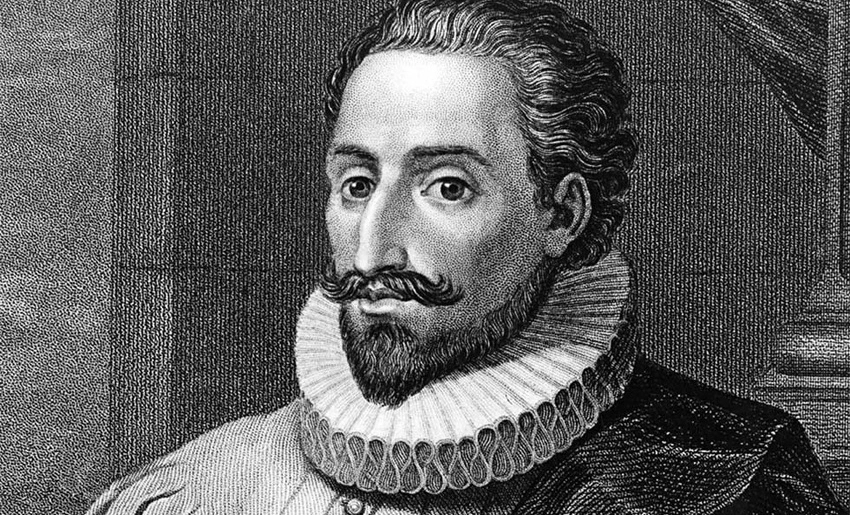
The name Miguel abounds in Spanish literature. If we want to mention some of the most important, we can find: Cervantes, Unamuno, Hernández, and Delibes.
Miguel Cervantes, whose first edition in 1605 marked 421 years since the publication of “The Ingenious Gentleman Don Quixote of La Mancha.” It continues to be the great classic of Spanish Literature of all time. So much so that the President of Spain, Pedro Sánchez, recently gifted it to the Governor of California, Gavin Newsom.
“It’s in Spanish, but I think it’s important for you to have this idealistic vision of fighting.” Remarked the head of the Spanish government, who, in a relaxed atmosphere after concluding a meeting in Germany on European security and defense spending. He joked about the book’s language. It’s the Castilian version. “I’ll have to work on that,” Newsom admitted.
The misfortunes in Cervantes’ life did not diminish his talent; quite the contrary. He was a soldier of the gallants (his left hand was rendered useless at the Battle of Lepanto in 1571). Also he was held captive by the Moors for five years in Algiers, he was never free of financial hardship. And he published his masterpiece when he was already 58 years old. Cervantes was a man of action and talent. So he never tired of writing, and his works include comedies, interludes, dramas, poems, and criticism. Cervantes lived 69 years, and José Martí remembers him as the greatest and most universal representative of the modern Spanish novel.
As for Miguel de Unamuno, the other great Miguel of Spanish Literature. It is worth mentioning that he was a professor of Greek at the University of Salamanca for 10 years. From 1901, served as rector of that institution until his death in 1936. In 1914, he had to resigned as rector of the University of Salamanca due to his comments against the King. Although he remained a professor of Greek at the renowned institution. To which he returned in 1930, during the Spanish Civil War.
Unamuno cultivated various genres: poetry, novels, criticism, and theater. His thought, which reflects his concern for the fate of the nation, influenced his work.
Hernández, the other great Miguel, died in the Ocaña prison on March 28th, 1942, at the age of 32. The death sentence handed down by a Falangist tribunal had been commuted to 30 years in prison. Which he was unable to serve, dying of tuberculosis and cutting short his literary career.
After his death, he became one of the most widely read poets in Spain and Latin America, possessing a distinctive style. We always remember Miguel Hernández through his verses: Singing I await death/for there are nightingales that they sing/ above the rifles/ and in the midst of battles.
And finally, I mention Miguel Delibes Setién (1920-2010), a Spanish novelist, journalist, and newspaper editor. Associated with the Generation of ’36 movement. From 1975 until his death, he was a member of the Royal Spanish Academy, where he sat in the chair for the letter “e.” Trained in commerce, he began his career as a caricaturist and columnist. He became editor of the regional newspaper El Norte de Castilla before dedicating himself exclusively to writing novels.
After his marriage, Delibes’s literary career took off definitively, beginning a three-year period that defined it. In 1947, he began writing his first novel, La sombra del ciprés es alargada (The Shadow of the Cypress is Long), which won the Nadal Prize the following year. Marking his arrival on the Spanish literary scene. His novel Aún es de día (It’s Still Day) was published, with heavy censorship, in 1948.
Cervantes, Unamuno, Hernández, and Delibes—the great Miguels of Spanish Literature—contributed to the universality of the Spanish language. Considered by specialists to be the language for speaking with God.

- Time Will Determine Where We End Up - 29 de September de 2026
- Journalism: The Great Novel of Daily Writing - 9 de September de 2026
- When Headphone Technology Can Affect Our Health - 9 de September de 2026