
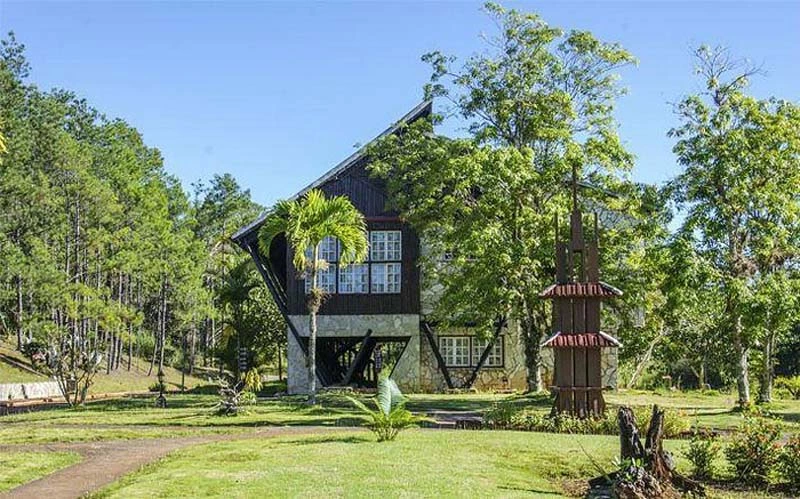
Pinares de Mayari is one of the most picturesque and unique spots in Cuba. With significant ecological, forestry, and scenic value. Its extensive pine plantations, red soil, viewpoints, and beautiful waterfalls confirm this.
In the mid-1960s, the only way to reach the plateau where this location is situated, now a protected area, was via La Bandera hill. Why the name? Because vehicles traveling along it couldn’t pass each other due to the narrowness of the access road.
Back then, drivers carried a flag which, upon reaching their destination. They would hand to those waiting to get out, and vice versa.
And in that exclusive world of nature, more than four decades ago, Commander-in-Chief Fidel Castro created a Technical Institute of Vegetables. Providing temporary tents for dormitories and classrooms for students and faculty from all regions of Cuba.
One day we were playing sports on a spacious esplanade in the center of the facilities when a four-door Gaz-69 jeep suddenly appeared. A bearded man in an olive-green uniform got out of the vehicle. We dropped our soccer ball and ran toward him. It was Fidel Castro.
We spontaneously formed a chorus around him. We all wanted to be as close to him as possible, until he told us: “Behave yourselves so I can talk to you. Next time I come, be more disciplined.”
That day, the school director, whose last name was Lara. Warned us not to rush toward Fidel when he returned.
And indeed, the second visit arrived. Again we ran, but as if in a kind of thought transmission, before reaching him we stopped almost simultaneously. He was accompanied by well-known political figures in vehicles that followed him.
On another occasion, he invited us to play baseball on a field already prepared next to the foothills of La Mensura. Almost a thousand meters above sea level, and to the facilities of the future institute. With its comfortable buildings, in contrast to the makeshift tents.
His team roster consisted of Fidel Castro, pitcher; the President of the Republic, Osvaldo Dorticós, second base. The President of INDER, José Llanusa, first base; and Osmani Cienfuegos, right field. I don’t remember the other players. And off the field, Celia Sánchez Manduley sat on the grass, while the Commander, a doctor named René Vallejo, moved from one place to another.
Our pitcher, a dark-skinned man from Guantanamo, wouldn’t throw the ball near the Commander when it was his turn, but the rebel leader, eager to get a hit, kept repeating, “You’re afraid I’ll hit it out of the park? Throw it over there…” At the end of the game, they beat us 8-6, and Fidel finished as the leader in walks.
But this wasn’t the end of our first year at the institute. On the final visit, we met with him again. This time, the eight brigades that made up the school’s structure were properly formed.
He began by talking about the importance of protecting the land for agriculture and ended by proposing a change to the center’s function.
Instead of the Technical Institute of Vegetables, he proposed changing it to the Institute of Soil Conservation. He put the proposal to a vote, and only two students didn’t raise their hands in approval.
When we broke ranks to return to our daily activities, like teaching or working in the tomato harvest, Fidel came back. We immediately lined up again, hoping for good news; but nothing. He came to where he was standing and raised his hand to take the rest of the tobacco he had placed on the fork of a bush as he walked toward us.
During those years, a mix of adolescence and young adulthood. I was struck by the fact that the country’s top leader came all the way from Havana to propose something like this and put it to a vote.
Later we learned that Fidel continued his tours of Pinar del Rio. A region characterized by a microclimate of frequent fog, cool temperatures, and ice-cold spring water. Its locations offer scenic viewpoints with spectacular geographical features. Such as El Guayabo waterfall, the tallest in Cuba, relatively close to his hometown of Biran.
With information from Roger Aguilera Morales/Cuban News Agency

- 7.6-Magnitude Earthquake Shakes Panama - 10 de October de 2026
- Etecsa completes work to modify its energy mix in Antilla - 10 de October de 2026
- Cooking with charcoal and firewood: the visible face of the energy blockade - 10 de October de 2026