
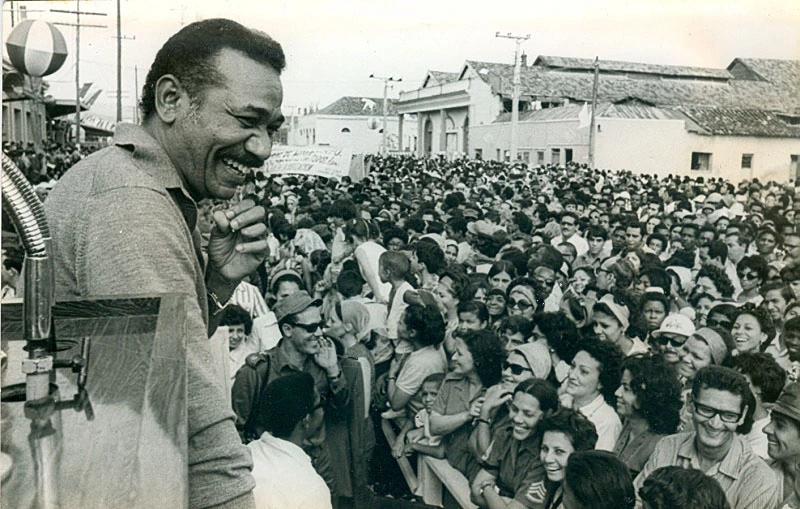
When the name Juan Almeida Bosque is mentioned, the first thing that usually comes to mind is the image of the intrepid fighter. The one who, in the bitterest moments of the war, when death lurked in Alegría de Pío. He stood tall and uttered that phrase that would become immortal: “No one here surrenders, damn it!”
But if there is one thing that those who knew him agree on. From his comrades in arms to the humblest peasant of the Sierra Maestra. It is that Almeida was a man who defied categorization. He was a human being of profound sensitivity. Where the fierceness of the guerrilla fighter coexisted in perfect harmony with the soul of the poet and the musician.
To delve into the Commander’s more human side. One must look not only to war reports or history books, but also to the musical notes of a bolero or the living memory of the people of Santiago. Luis Estruch Rancaño, a doctor and researcher who shared decades of close contact with Almeida. Defines him in his book “Juan Almeida Bosque: Testimony of a Man from Santiago (1970-2009)”. As a “multifaceted man of exceptional greatness.” In him, he asserts, popular roots were combined with a sensitivity sufficient. To respond to his responsibilities not only from a political position, but “from an understanding of social issues and exemplary conduct.”
Almeida never forgot his humble origins in the Los Pinos neighborhood of Arroyo Naranjo. The man who became Commander of the Revolution and Vice President of the Council of State never lost touch with the land. Those who saw him travel through the fields and cities of the former Oriente province. Recount how he would sit and talk with the shoeshine boy. Share time with the bricklayers while overseeing the construction of houses. And how he took an interest in the peasants’ problems with the same ease with which he would later wield a weapon. He embraced, like few others, Martí’s maxim of casting his lot “with the poor of the earth.”
But perhaps Almeida’s most intimate side, the one that brings him closer to the everyday heart of the people, is that of the composer. It is said that he began writing songs almost at the same time as the struggle began. As if music were a necessary refuge for the guerrilla fighter’s soul. Author of more than 300 musical works, his repertoire ranges from danceable guarachas to the most heartfelt boleros that have resonated through generations.
“La Lupe,” that anthem of romantic love in Cuba, was born from a genuine feeling for a Mexican woman he met during his exile. So even today, decades later, it continues to resonate in homes and bars across the island. Songs like “Dame un traguito” (Give Me a Little Drink), “Mi Santiago” (My Santiago), and “Marinero quiero ser” (I Want to Be a Sailor). Which marked the childhood of many Cubans, reveal a man who could translate the deepest beats of the national soul into melody.
Journalist and critic Giovanni Luis Villalón emphasizes that Almeida was “a natural leader of the people, because he came from them.” This quality allowed him to share the everyday tasks with the same simplicity. With which he shared time with musicians, visual artists, and theater directors at the Egrem Siboney Studios in Santiago de Cuba. A facility he himself founded and protected as a space for art.
Also that is why, when his heart stopped on September 11th, 2009, the country felt an immense void. But Fidel Castro, in those sorrowful hours, uttered the words that would be etched in the collective memory. “Let’s not say that Almeida has died! He lives today more than ever!”
Today, on the 82nd anniversary of his birth, the people do not remember him with rigid mourning. They remember him humming one of his songs. Visiting his tomb in the mausoleum of the Third Eastern Front. Or simply repeating, in the face of any adversity, that legendary “Here, no one surrenders!”
Almeida demonstrated that one can be both hero and human. That greatness is not incompatible with tenderness, and that a man who wielded a rifle with honor could also caress a musical staff with the same passion.
That is the Almeida who does not die: the Almeida of the combatant, the artist, the friend. The Almeida of the people.
By: Daimy Peña Guillén

- Social transformations analyzed during meeting with Minister of Labor in Holguin - 9 de October de 2026
- Tradition and Color at Iberoart Fair in Holguin - 9 de October de 2026
- Japanese delegation inspects startup of Caletones desalination plant - 9 de October de 2026