
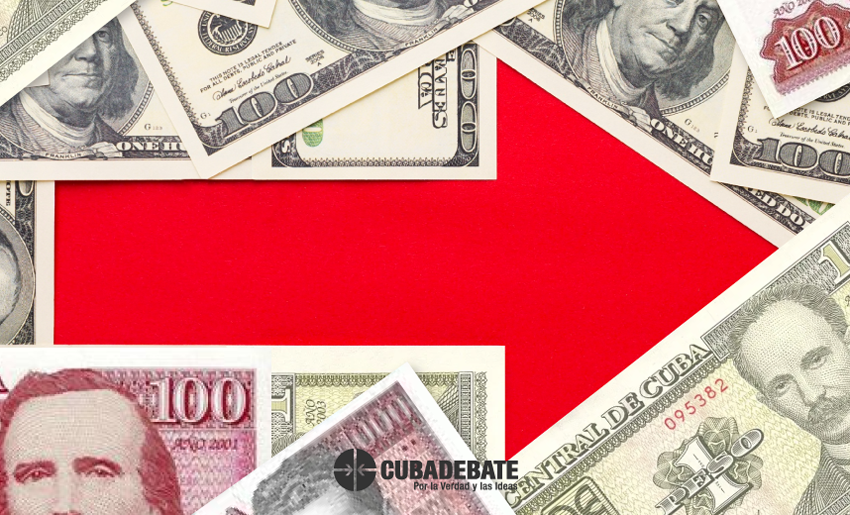
The economic scenario facing the Cuban nation today is undoubtedly one of the most complex in its recent history. Analyzing the erosion of our currency’s purchasing power, the advance of inflationary pressures, and the battle for control of trade, the goal is not to identify a single breaking point. But rather to understand the confluence of structural, external, and regulatory factors that shape the current reality.
This analysis must include the situation of those who depend on pensions and the basic salary.Ssectors that most starkly demonstrate the gap between nominal income and the real cost of living.
The Cuban peso did not lose its value overnight, nor as a result of a single administrative decision. Economic experts point out that the most severe turning point occurred after the implementation of the Economic Reorganization Plan in January 2021. Also when the dual currency system was eliminated and a single exchange rate of 24 CUP to 1 USD was established—the first official devaluation of the peso since 1959.
However, the revolutionary government has been transparent in warning that this measure was not a “magic bullet.” But rather a necessary condition to correct the macroeconomic imbalances inherited from decades of distorting subsidies.
What we observe today—with an informal exchange rate that has reached peaks exceeding 450 CUP per dollar—is the result of a perfect storm. The unprecedented intensification of the economic blockade, external financial persecution, and a media war that induces inflationary expectations to destabilize the country.
Addressing the nature of imports requires conceptual precision. Claiming that these “are not controlled by the Cuban state” does not correspond to legal and factual reality. What is happening is a different phenomenon: the presence of new economic actors (MSMEs and self-employed workers) who, under a regulatory framework that could be improved, are participating in import chains.
Prime Minister Manuel Marrero has explained that the partial dollarization of the economy is a temporary measure. Adopted under conditions of economic warfare. To capture foreign currency that would otherwise escape the formal circuit and to stimulate supply.
The State maintains its leading role: it sets the official exchange rate, establishes a discretionary rate of 120 CUP for essential services and tourism, and regulates financial operations, while the Central Bank of Cuba’s exchange rates hover around 458 CUP daily.
However, a structural contradiction persists. While the state sector and a large part of the population without remittances operate in pesos at official or subsidized rates. Much of the private sector sets its prices based on the informal exchange market rate (490 CUP). This creates an asymmetry that the government has openly acknowledged as an “undesirable widening of social inequality.”
It is precisely at this point that the work of the inspection agencies and the new legal provisions become vitally important. Far from inaction, a regulatory offensive is underway. Last year, a new foreign exchange allocation mechanism was approved, fiscal control measures were consolidated. Identifying debts of more than 9.8 billion pesos, and sanctions were applied. Including the temporary or permanent closure of more than 23,000 establishments.
The Ministry of Finance and Prices, through resolutions such as 225/2024, has imposed price caps on high-demand products. The inspection team has carried out more than 1,200 forced sales—a figure that is insufficient given the country’s current economic situation—and maintains a daily fight against speculation and illegal activity.
So the answer lies not in the absence of regulations or a lack of will to control, but in the nature of the phenomenon. We are facing induced inflation. It is not simply an imbalance between supply and demand. It is the result of price manipulation by actors who, taking advantage of scarcity, impose abusive profit margins based on the speculative exchange rate of the dollar.
This analysis would be incomplete without considering the situation of the more than 1.5 million Cubans who depend on the social security system. In September 2025, Resolution 14/2025 of the Ministry of Labor and Social Security came into effect, establishing partial increases for 88% of the beneficiaries of the General Social Security System.
According to official data, the old-age and disability pension for retirees under the general system—those with amounts up to 2,472 pesos—received an increase of 1,528 pesos. People who earned between 2,473 and 3,999 pesos per month saw their pensions adjusted to reach
The path to macroeconomic and monetary stabilization is rocky and fraught with risks. The country’s leadership has been clear in warning that there are no magic bullets. The measures adopted—monetary unification, controlled opening to certain forms of management, partial dollarization, price caps, and pension increases—are not ends in themselves. But rather links in a larger program to correct distortions and revitalize the economy.
Moreover the battle against speculators and the defense of family income will continue to be a daily struggle. Especially for those who have already dedicated their entire lives to the Revolution.
By: Daimy Peña Guillén

- Holguin Health Sector Strengthens Ties with Adolescents and Youth - 1 de October de 2026
- Trump’s measures against Cuba: another step toward strangulation - 1 de October de 2026
- Cuba prioritizes respect and care for older adults - 1 de October de 2026