The province of Holguin is promoting the deployment of renewable energy sources. With projects that are bringing tangible transformations to rural communities and essential services.
These projects are coordinating international initiatives with national programs. Fostering strong local participation focused on the most vulnerable sectors.
Among the international projects underway, FORMER stands out. This collaborative initiative between the governments of Cuba and Canada and the company Sherritt International is valued at over seven million Canadian dollars. With a local contribution exceeding 20 million Cuban pesos from the National Union of Electricity Producers (UNE).
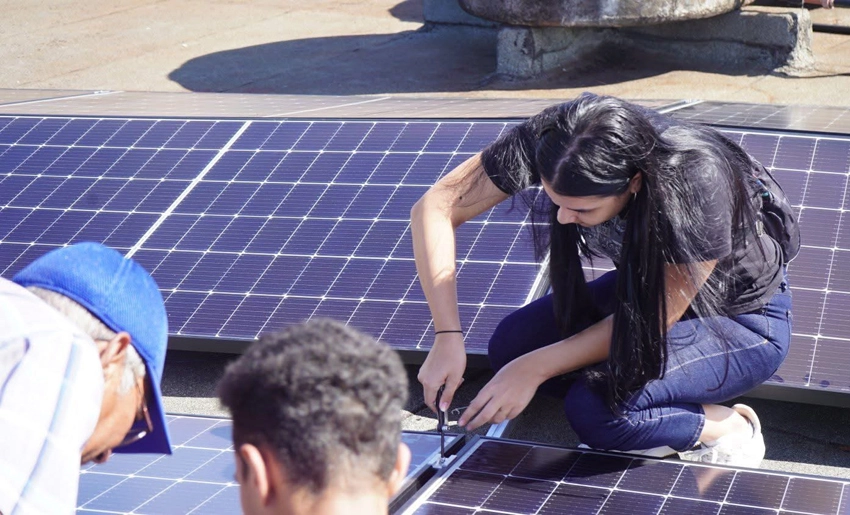
Its main objective in Holguin is to install 502 stand-alone photovoltaic systems (SFVA) of 1 and 2 kW in vulnerable rural communities. Where access to the National Electric System (SEN) is limited or nonexistent.
As a result of this effort, 291 of these systems have been installed to date, representing 50.4 percent of the target. These systems are distributed across 29 communities in 10 municipalities. Prioritizing households headed by women, according to criteria defined by the donors. This explicitly incorporates a gender perspective into the implementation of the investments.
According to the work plan, the province should complete the 502 installations by March 2026. This represents a significant leap forward for families who previously relied on generators with limited service or small 300W systems. While simultaneously strengthening women’s leadership in the renewable energy sector and in community management.
At the same time, the deployment of renewable energy sources in Holguin is not limited to electricity generation. As it includes the use of solar water heaters in healthcare facilities and social service centers. Currently, 87 units are installed at the Holguin Pediatric Hospital. Several daycare centers in Moa—such as Florecita del Atlántico, Tierno Amanecer, Dulces Caricias, Pequeños Industriales, and Pequeños Constructores—and senior citizens’ homes, maternity homes, and polyclinics in the municipality.
Building on this experience, a 35 kWp photovoltaic system was also completed in Moa above the hospital laundry. Along with the rehabilitation and installation of two water pumps. This reduces consumption during peak hours and alleviates the load on already saturated networks. While also strengthening the guarantee of basic services such as water supply and hospital hygiene.
Meanwhile, in Aguaceros, electrification via the National Electric System (SEN) is being combined with a small 24 kWp photovoltaic park. Also while new power lines are being installed, access roads are being rehabilitated, and other construction phases are being carried out in coordination with entities such as ECM Antilla. This will increase the resilience of the system. Diversify the local energy mix, and reduce the vulnerability of rural settlements to service interruptions.
Meanwhile, in Aguaceros, electrification via the National Electric System (SEN) is being combined with a small 24 kWp photovoltaic park. New power lines are being installed, access roads are being rehabilitated, and other construction phases are underway in coordination with entities such as ECM Antilla. This will increase the system’s resilience. Diversify the local energy mix, and reduce the vulnerability of rural settlements to service interruptions.
Alongside these actions, the program known as LEMI is being implemented. Which has enabled the installation of photovoltaic systems in 458 homes across 14 municipalities in Holguin province—including Antilla, Baguanos, Banes, Cacocum, Calixto García, Cueto, Frank País, Gibara, Holguin, Mayari, Rafael Freyre, Sagua de Tanamo, Moa, and Urbano Noris—out of a total of 503 systems allocated to the province. This figure represents 10.16 percent of the national goal of 5,000 photovoltaic systems.
Taken together, this map reflects a concrete commitment to reducing territorial disparities and ensuring that the energy transition is measured not only in megawatts but also in the lives of families.
Fernando Hechavarría Pupo emphasizes this point, noting that each installed system “is a house that no longer depends on diesel. A school that can operate more reliably, and a doctor’s office that gains security for its medical equipment.”
By: Jorge Alejandro Fernández Pérez

- Mendive, the Teacher of José Martí - 23 de October de 2026
- UHo Participates in the 16th RED-DEES Meeting in Uruguay - 23 de October de 2026
- Jorge Gómez: 47 Years Behind the Wheel at Radio Angulo - 22 de October de 2026