
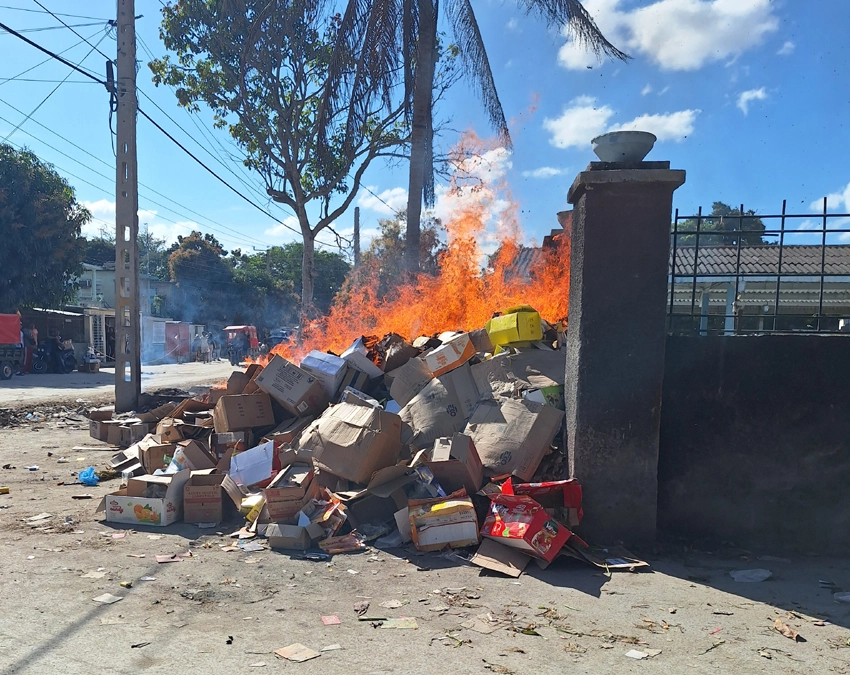
Holguin, once recognized as one of the cleanest cities in Cuba, now faces a public health crisis that jeopardizes the health of its population. The uncontrolled accumulation of solid waste and open burning of garbage have ceased to be a simple urban planning problema. And have become a serious threat to the well-being of the population.
This situation is reflected in concrete figures. In the city of Holguin alone, it is estimated that each person generates approximately 1.5 kilograms of waste per day. An amount that multiplies with the activity of businesses and new forms of economic management. However, the capacity to dispose of this waste is insufficient. Collection is limited by a chronic shortage of resources. Also there is a lack of garbage trucks, spare parts, fuel, and Manpower. Which generates prolonged delays in neighborhoods such as Libertad, Villa Nueva 1, Alcides Pino, Salida a San Andrés, and El Llano.
Far from being an aesthetic problem, accumulated garbage is a vector for disease. Dr. María Eugenia Escobar Pérez, a specialist in Hygiene and Epidemiology. She warns that scattered waste provides shelter for rodents, insects, and stray animals, becoming breeding grounds for disease.
Dr. Geanela Cruz Ávila, director of the Holguin Provincial Center for Hygiene and Epidemiology, reported that in the province, during the last month, there has been an increase in treatments for specific febrile síndromes. In which, combined with the high concentration of Aedes aegypti mosquitoes, represents a high risk for the transmission of arboviruses. She also confirmed that environmental factors directly influence the morbidity of leptospirosis and dengue in the province.
In 2023, 17 cases of leptospirosis were reported, with a rising mortality rate. Mainly linked to the high rodent population and poor sanitation. However, an even more dangerous practice exacerbates this health emergency: The illegal burning of garbage.
In the community of Villa Nueva, a massive illegal dump located less than 200 meters from homes is periodically set ablaze as a method of “control.” This act, far from solving the problem, generates dense clouds of toxic smoke that drift through the city. According to residents and specialists, this smoke contains fine particulate matter, dioxins, furans, and carbon monoxide. Highly carcinogenic substances that are already causing a noticeable increase in asthma attacks, allergies, respiratory infections, and severe headaches among residents.
Faced with this reality, it is crucial to remember the Cuban regulatory framework that seeks to prevent this harm. There are health regulations stipulating that a dump must be located no less than 500 meters, and even up to one kilometer, from residential areas. A distance that is flagrantly violated in cases like that of Villa Nueva. Likewise, Decree Law No. 272 of 2001, concerning violations of land-use regulations. It continues to be enforced, as demonstrated by the more than 24,000 fines issued in the province during the past year. These legal tools show that the country has a regulatory framework geared towards environmental and citizen protection.
Moreover the solution, therefore, requires urgent, concerted action that goes beyond isolated measures. The Municipal Services Company in Holguin has attempted strategies with the Community Councils to reach critical areas and has managed to incorporate some resources. But admits that the challenges are greater. Experts insist that effective alternatives must be sought that allow for a minimum collection once or twice a week in all neighborhoods. In addition to rigorously monitoring compliance with the collection routes.
Burning garbage is not a solution; it exacerbates the problem and worsens the crisis. Far from eliminating waste, this uncontrolled practice transforms it into an even more toxic and harmful threat to the environment and public health. The resulting smoke releases carcinogenic substances such as dioxins and furans.
As well as fine particulate matter that penetrates deep into the lungs. Exacerbating chronic respiratory illnesses, triggering asthma attacks, and causing acute poisoning. Contrary to the spirit of Cuban environmental legislation, which promotes comprehensive and sustainable management. Burning constitutes a deliberate pollution of the air breathed by Holguin residents.
Consequently, it doesn’t solve the underlying problem—the accumulation of garbage due to lack of collection—but rather transforms it into a permanent health emergency. Diverting attention and resources that should be allocated to structural solutions. Such as strengthening collection services, recycling, and environmental education.
The health of Holguin is at stake. Medical evidence and the voices of citizens agree: the accumulated and burned garbage is not just an unpleasant sight, it is a trigger for preventable illnesses. Resolving this crisis demands prioritizing environmental sanitation. As an investment in public health, strengthening community services with the necessary resources, and promoting responsible social discipline. Also where every citizen and entity assumes its role. Only in this way will Holguin be able to recover not just its cleanliness, but the fundamental well-being of its people.
By: Alvaro Raúl Suárez Leyva

- China Supports Cuba’s Sovereignty in Face of Arrest Warrant for Raúl Castro - 22 de October de 2026
- Progress in Power Sector Transformations Confirmed in Holguin - 22 de October de 2026
- Baseball: “Wasps” Reclaim the Eastern Throne - 22 de October de 2026