
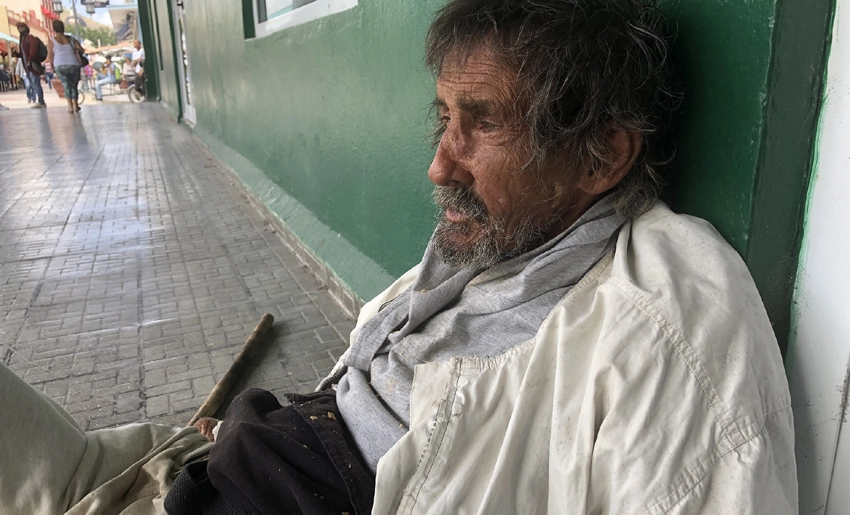
The presence of homeless people on street corners and in alleyways in the city of Holguin is more than just a recurring image. It is an urgent call to collective conscience. This phenomenon, far from being a simple reality accepted by many, has become a multifaceted challenge that exposes deep vulnerabilities in the social and mental health fabric.
Seeing these vulnerable individuals in alleyways, on street corners in the city center, or standing in front of businesses is now almost a common sight in the Cuban City of Parks. But, faced with this situation, the province is not standing idly by. Instead, it is developing a response that combines institutional action with essential citizen mobilization.
Also the Cuban State, in accordance with its principle of leaving no one without support, has deployed resources over the years. Which, while concrete, do not solve the problem. Even though Holguin has a Rehabilitation and Social Reintegration Center that offers comprehensive protection, rehabilitation, and a path to reintegration, the necessary results are not being achieved.
Nevertheless, Holguin’s health system is strengthening its capabilities. From the long-standing and well-established work of Villa Quinqué in addiction treatment to the ongoing training of its professionals. As evidenced by events such as the Holguin Mental Health Symposium held in 2025.
However, national figures reveal the complexity of the challenge. More than 3,700 people experiencing homelessness are receiving care. With a profile that includes psychiatric disorders, alcohol abuse, and the breakdown of family support networks. These data confirm that no single institution can resolve this web of deficiencies on its own. This is where the Cuban social model reveals its potential strength: the solution urgently demands the active participation of the community.
For this reason, the work of mass organizations such as the Committees for the Defense of the Revolution (CDR) and the Federation of Cuban Women (FMC) becomes an irreplaceable link. Their work on the ground—early detection, support for families, and the fight against stigma—acts as a vital bridge between people in crisis and institutions.
The family doctor and nurse, for their part, carry out monitoring and follow-up work that is fundamental to a preventive strategy. Beyond institutions, the decisive battle is fought in social perception. Every citizen who stops seeing a human being as an obstacle and recognizes in them a neighbor in crisis contributes to the solution.
Community empathy is the indispensable complement to social policy. The innovation demonstrated during the pandemic, with remote psychological support protocols from the Lucía Íñiguez Landín Clinical Surgical Hospital. So it shows the capacity for adaptation to reach those who need it most.
Moreover the path is arduous and resources are limited, but Holguin demonstrates that progress is being made with a commitment to inclusion. The goal is to transform the common perception of hopelessness into proof of the power of social cohesion.
Finally this is a challenge where responsibility is shared: the State provides the essential frameworks and resources. But it is the vigilant, supportive, and active community that ultimately weaves the safety net that prevents anyone from falling into oblivion. In this combined effort lies the true strength to confront this problem and build, together, a more fully protective society.
By: Daimy Peña Guillén

- Living Memory Against Terrorism - 12 de October de 2026
- Boca de Sama: Where Terrorism Shattered the Calm - 12 de October de 2026
- Virtual Health Innovation Event Held in Holguin - 12 de October de 2026