
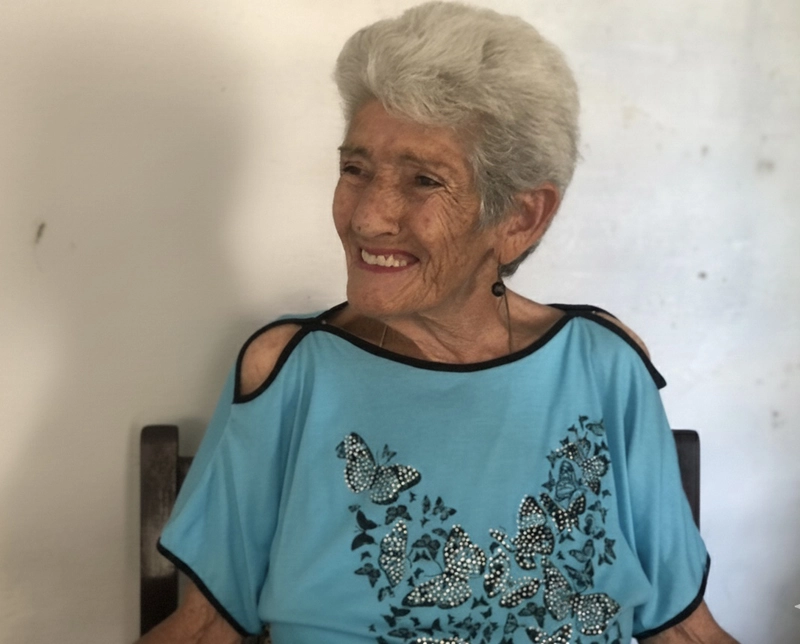
As part of the celebration of Teacher’s Day in Cuba, every December 22nd, we remember those men and women who answered the Revolution’s call to shape the future. Luz María Enríquez Ferrer, a woman from Holguin with a serene voice and unwavering convictions, was one of them.
At just 14 years old in 1966, she left for the Sierra Maestra mountains in Santiago de Cuba to train as a primary school teacher in a historic contingent. Today, her story is a living testament to sacrifice, love for the profession and an unwavering faith in the transformative power of education.
“This was Fidel’s idea,” she begins, recalling the origins of her vocation. “When the country ran out of teachers, Fidel called for training. And this vocational center was created. I joined the third contingent when I was 14. My father didn’t want me to go, but there I was.”
Her story transports you back to that school in Minas del Frio. A vast area where thousands of young people from all the provinces lived together. “My contingent had about nine thousand students,” she specifies. The conditions were extreme, a trial by fire. “We slept in hammocks, tying up here, tying up there. The water shortage was so severe that we could only bathe every other day. But we were aware that we were there for something big.”
Also the academic training, however, didn’t stop. With minimal resources, classes were held outdoors. “The boys, up in the mountains, cutting branches, built my classroom.
Each one of them invented his own seat. I, leaning against the earth on the same hillside, carved out a space and settled in.” Despite everything, the teaching process was rigorous. “We received instruction in Spanish, Math, Biology, Geography… The objective was clear: to prepare us to be teachers. There, under the clouds, I learned that willpower is the most important teaching material.”
That period, marked by harsh trials and acts of terrorism that sowed fear among the students, ultimately defined their resilience. “There were nights of great terror… screams, confusion, and they made us stand, singing patriotic hymns until dawn. But there were also Fidel’s speeches. Which we listened to with devotion, sometimes until two in the morning. All of that, although very hard, forged a special courage in us. The bravery of those of us who stayed was an act of conviction. They needed us.”
“From Makarenko to Prison: Every Classroom Was a Life Lesson”
After the Sierra Maestra, her education continued at the Antón Makarenko Institute in Tarara, Varadero. “It was a different life there, but just as disciplined. We had to march like soldiers. We were practically cadets.” It was there that she solidified her profile as a history teacher, a subject she feels is a mission. “I liked history, I prepared myself, and I started teaching. That institute gave me the structure, the methodology. Everything I learned there served me well in the future.”
Her career took her through various fields: primary school, junior high school, the emblematic Holguin Vocational School. Also the Polytechnic Institute of Health, and finally, a profoundly human challenge: the Provincial Prison.
“I have countless experiences there,” she says, her gaze filling with a special intensity. “I worked with inmates. For me, it was a different environment, but that whole process. Every classroom, made me more Cuban, more human.” She recounts the story of a young man who, under her tutelage, discovered teaching.
“He became my support, studying history, even though he claimed to know nothing… and he ended up teaching classes himself. Seeing him transform, take on the responsibility, was seeing how education strengthens values even in the most complex circumstances.”
For Luz María, the greatest satisfaction comes from the recognition of her students, many years later. “Not even two months ago, a former student from the vocational school stopped me in the street. He said, ‘Teacher, you have no idea how much I admire you. Every time I talk to a young person, I tell them: if you had had the teachers we had, you would love your country more.’” And she concludes, with restrained emotion: “That is priceless. It’s confirmation that it was all worthwhile.”
Moreover for Luz María, the meaning of her profession transcends the professional. In her view, being a teacher has been the constant task of shaping human beings day after day. Every student who has passed through his life. Whether in a humble primary school, a demanding vocational school, or even behind bars, is a reminder that it is possible to instill awareness, responsibility, and patriotism. “That is the true power of the educator. To see a person rediscover their worth and their love for their country through knowledge.”
When asked about her message for the new generations, her voice fills with an urgent plea: “Today more than ever, Cuba needs teachers. I’m not telling you it will be easy, because it never was. I’m telling you it will be the most worthwhile task of your lives. Study, prepare yourselves, be those dignified and revolutionary professionals who transform lives and defend sovereignty from the classroom. In your hands will be the future that we began to build here in the Sierra, with a pencil and a notebook.”
With the peace of someone who has fulfilled her duty, Luz María Enríquez Ferrer looks back without a hint of doubt. “If life gave me the choice again, I would take the same path. With its difficulties, its long nights, everything. Because this profession didn’t give me material wealth. But it filled my life with a lasting richness: the respect of my people and the certainty of having served.”

- Social Media: A Mirror of Our Humanity - 30 de June de 2026
- The Legacy of Vilma Espín, 19 Years Since Her Passing - 20 de June de 2026
- Aging with Dignity: A Call to Awareness Regarding Elder Abuse - 15 de June de 2026