
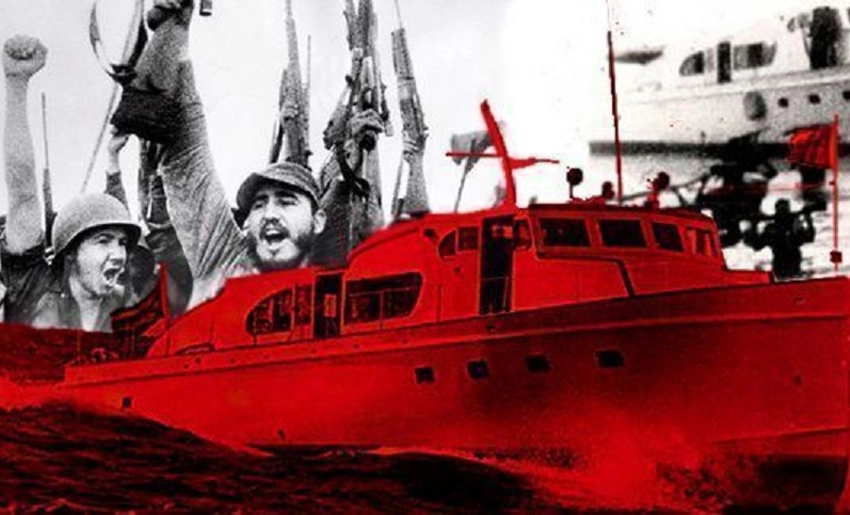
Today, Cuba commemorates the 69th anniversary of the Granma yacht landing. A heroic feat in which 82 revolutionaries, led by Fidel Castro, reignited the definitive struggle for national sovereignty.
This date, which also marks the Day of the Revolutionary Armed Forces (FAR), transcends the historical event. It represents the foundational core of the humanist and resistance principles. That define the character of the nation and its institutions.
Moreover the journey of the small Granma yacht—designed for 20 people but carrying 82 expeditionaries, their weapons, and supplies. It was from the outset an extreme test of the human spirit.
The men suffered from seasickness and vomiting due to the heavy swell. Crammed into a confined space and surrounded by the pervasive smell of oil. Ernesto Guevara, the expedition’s doctor, recounted how most of them lay prostrate, clutching their stomachs. But this could not halt their advance, much less break their ideals.
In the midst of the difficult navigation, a wave swept expeditionary Roberto Roque into the sea. Faced with the danger, Fidel Castro ordered the march to stop and dedicated almost an hour to the search, until he was rescued alive. This act, prior to any combat, symbolized the unwavering commitment to the life of each comrade. A value that would become a fundamental principle.
The landing at Los Cayuelos, near Las Coloradas beach, was not the triumphant arrival of an invincible army. But the perilous beginning of an unequal struggle. After the dispersal in the battle of Alegría de Pío, the reunion of the survivors—the moment when Fidel, upon joining Raúl and adding their rifles together, exclaimed: “Now we will win the war!” Demonstrated that true strength lay in unwavering unity and faith in their purpose.
From the Rebel Army to the FAR: Defense and Service to the People
From that core of survivors, the Rebel Army was born. Which, after the triumph of 1959, gave way to the Revolutionary Armed Forces (FAR), officially established in 1960. The FAR inherited and institutionalized the humanism of the Granma expedition. Transforming the classic concept of national defense.
For Cubans today, this anniversary has a profound and multifaceted meaning. It leaves us with a lesson in national resilience: the landing symbolizes the capacity to resist and be reborn in the face of seemingly insurmountable adversity. A narrative that resonates in the country’s current context.
Futhermore this serves as a reminder that true power lies not in technology or numbers, but in the righteousness of a cause, popular support, and moral strength. The Revolutionary Armed Forces (FAR), with their integration of regular troops and territorial militias, embody the concept of “the people in arms.”
Finally the legacy of the Granma is projected globally through solidarity, particularly in Cuban medical missions. As Fidel Castro stated, “To be internationalist is to repay our own debt to humanity.” Today, with collaboration in more than 60 countries. These “armies in white coats” are the living expression of the humanism that was born in the Gulf of Mexico.
December 2nd is more than a date of remembrance. It is a mirror in which Cuba recognizes itself.
The small vessel Granma carried not only men to a swampy beach, but also the seed of an ethic. That the ultimate strength of a nation lies in its unity, dignity, and capacity to serve. Both within and beyond its borders. This is the victory that, 69 years later, is defended every day.
By: Daimy Peña Guillén

- Cuban Foreign Minister Denounces U.S. Pressure Regarding Votes Against the Blockade - 21 de October de 2026
- Second Phase of the “Sowing Life” Project Launched in Holguin in Cooperation with Mexico - 21 de October de 2026
- Visual Arts Exhibition Dedicated to Fidel Castro Opens in Holguin - 21 de October de 2026