
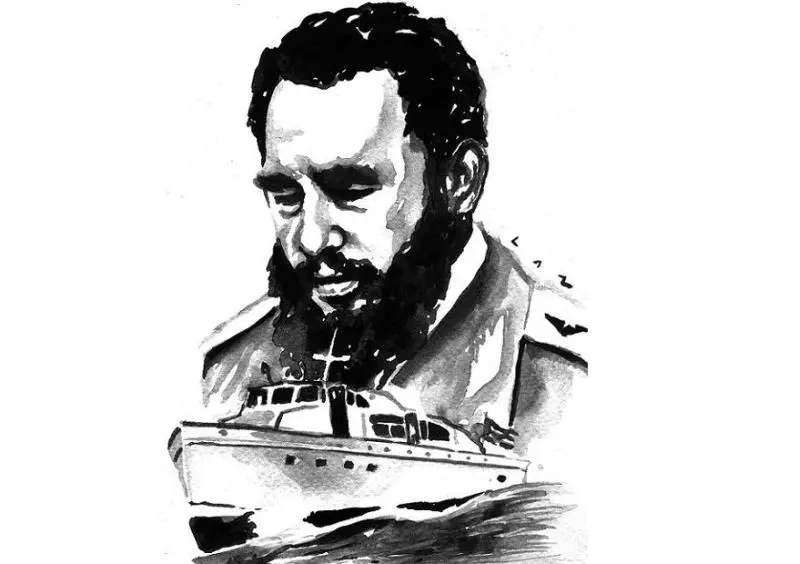
In the murky early morning of December 2nd, 1956, the sea was still dark when a white hull made its way through the mangroves. A short distance from Las Coloradas beach, in the south of the former East province. It was not a pleasure yacht, despite what the paperwork indicated. It carried 82 men crammed into the hold and on deck, a cargo of rifles, and a shared certainty.
They had come from Tuxpan, Mexico, after a longer and more arduous voyage than anticipated. Battered by seasickness, rain, and overcrowding, they clung to the inner compass that guided them toward history. The Granma yacht, purchased as an old pleasure boat and transformed into a revolutionary vessel, had begun its journey on November 25th.
Now the yacht ran aground on a mangrove tongue, and the planned landing on the light sands of Las Coloradas became a hand-to-hand battle against the swamp. At the appointed hour, they had to jump into the water, clutch their rifles to their chests, and advance. Step by step, mud rising up their legs and the horizon still shrouded in shadow.
The expedition members climbed off the Granma as best they could. Some slipping, others helping a comrade who sank a little deeper into the swamp. The yacht, half-freed of its human cargo, lay still, now more of a symbol than a vessel, while the column stretched out in disarray toward dry land. Trying to leave behind the smell of fuel, salt air, and controlled fear.
Among those advancing were names destined to later populate the annals of history: Fidel and Raúl Castro, Ernesto “Che” Guevara, Camilo Cienfuegos, Juan Almeida Bosque, and many others who were then nothing more than soaked young men. Their shoes caked in mud, certain that every meter gained from the swamp was a meter gained toward the future.
The original plan called for a swift landing and a relatively short march to the Sierra Maestra. Also where the friendly terrain would serve as both a shield and a military training ground. When they finally reached firmer ground, fatigue had no right to prevail.
They had to regroup, check weapons, count men, assess strength, and try to give that expedition the order of a company that was still being formed amidst improvisation. From the sea to the jungle, the journey was made with discipline and faith.
Moreover the dictatorship, alerted, was quick to make its presence felt. The expeditionaries’ baptism of fire and the Batista army’s attack. With the advantage of terrain, ammunition, and organization, in a hunt that stretched for days in the vicinity of the landing. It began to be tallied immediately in dead, prisoners, and isolated groups.
Also the days following the landing were perhaps the most fragile of the entire epic. The pursuit left a painful toll of dead combatants, several of whom were executed after being captured. While small groups tried to make their way into the mountainous interior of East province. The Revolution seemed on the verge of foundering on solid ground.
Futhermore the date at Cinco Palmas marked a turning point. After days of uncertainty and silence. Fidel and Raúl Castro reunited there, accompanied by a handful of exhausted men armed with very few rifles. What at first glance might have seemed like the end of the undertaking was instead embraced as the minimum core from which to begin again.
In honor of that event, every December 2nd Cuba commemorates the Day of the Revolutionary Armed Forces. Paying tribute to those 82 men who, under extremely adverse conditions, inaugurated the final stage of the struggle for definitive emancipation.
By: Jorge Alejandro Fernández Pérez

- Jorge Gómez: 47 Years Behind the Wheel at Radio Angulo - 22 de October de 2026
- Cuba Begins Its Journey Toward the U-18 Baseball World Cup in the Dominican Republic - 22 de October de 2026
- China Supports Cuba’s Sovereignty in Face of Arrest Warrant for Raúl Castro - 22 de October de 2026