
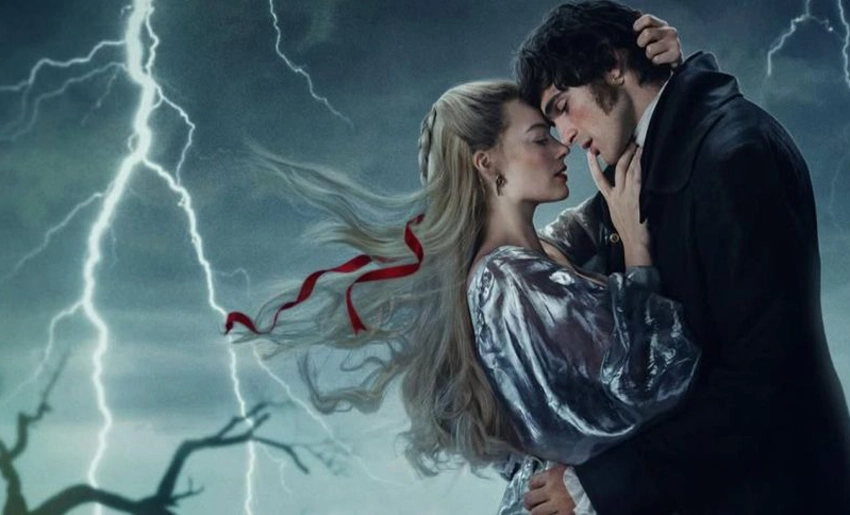
It’s not a love story. It’s a story of ownership, revenge, and a thirst for the absolute that death cannot quench. Bringing Wuthering Heights to the big screen has always been an act of suicidal audacity. It’s not just adapting a novel; it’s trying to bottle a lightning bolt.
The recent film version has arrived in our theaters and online with the roar of a storm on the Yorkshire moors. Forcing us to wonder, between the steam of coffee and the glow of the screen. If this modern Heathcliff has the necessary “ache” to sear our memory as Emily Brontë’s pen did.
From the very first frame, the film assaults us with a visual style that is both its greatest glory and its own trap. Recent art criticism has been quick to point out its stark neo-Gothic aesthetic. Which eschews postcard-perfect preciousness in favor of embracing mud and mist.
It’s an undeniable technical triumph: the cinematography seems lifted from a Friedrich canvas. Also where man is an insignificant stain before the hostile backdrop of nature. However, in this pursuit of perfect composition, the film sometimes remains stuck in the “tableau vivant.” Losing the heartbeat of a story that, more than being seen, should be felt like an open wound.
Linked to this visual coldness, we stumble upon the great sacrifice of the production: the silencing of words. Emily Brontë didn’t write dialogue. She cast spells, bursts of a metaphysics of desire that bordered on the sacred. “I am Heathcliff,” cried the literary Cathy. Decreeing a fusion of souls that contemporary cinema has chosen to whisper or, worse still, omit.
By favoring expressive minimalism and contemporary naturalism, the screenplay strips the work of its incendiary preciousness. One misses that savage rhetoric that transformed each encounter into a duel of titans. Here, passion is reduced to the physical, neglecting that “inner fire that cannot be explained with images.” Rather with the eloquence of one who knows that love is a form of absolute possession.
This lack of sacred language inevitably influences the evolution of its protagonists, who walk across the screen like shadows of a myth.
Moreover the Heathcliff of this version is a force of nature. An animal wounded by class hatred and contempt. Achieving a transformation from pariah to demon that is, perhaps, the film’s strongest point. But woe to our Catherine! In this version, she seems more a victim of circumstance than that selfish. A volcanic force who would rather shatter the world than bend her will. On paper, they were two celestial bodies colliding. On screen, they are two misunderstood young people in the rain. Losing that touch of “Greek fatalism” that makes the novel timeless.
Infographic about the film Wuthering Heights. However, it must be acknowledged for a merit that many previous versions cowardly ignored: the inclusion of the second generation. By rescuing Catherine the daughter and Hareton, the film understands that the tragedy of the Earnshaws and the Lintons is not a seasonal romance; but a saga of degradation and redemption that transcends time. It is here that the film recovers some of that epic sweep. Showing us that, although hatred is a heavy inheritance, there is always a corner for light among the ruins of the mansion.
In short, we are faced with a feast for the eyes that leaves us literaryally starved. It is a necessary work for understanding how contemporary cinema attempts to tame the untamable. For the Cuban reader—always thirsty for vibrant language—it remains halfway between art and artifice.
It’s beautiful, yes, and as harsh as an English winter, but it lacks that mystical “something” that makes us leave the theater feeling that we, too, are the moor. A moor so enveloping, with the image created by Emily Brontë. That it makes you wish you could change the novel’s ending and have Heathcliff find Catherine alive.
By: Daimy Peña Guillén

- Holpes Recognized for Business Achievements in Holguin - 9 de April de 2026
- Wuthering Heights: Homage or Shadow of Brontë in New Cinema? - 9 de April de 2026
- Mining Brigade Receives May Day Flag in Holguin - 9 de April de 2026