
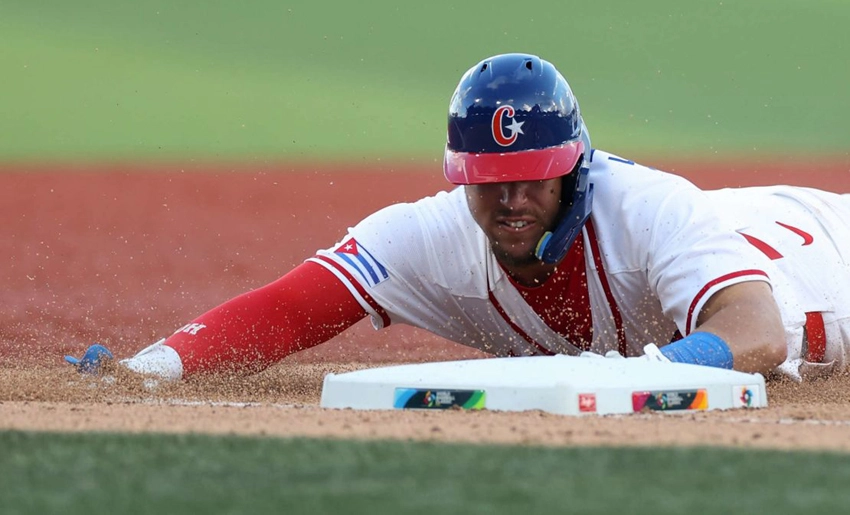
Cuba brought its journey in the VI World Baseball Classic to a close this Wednesday, losing 7-2 to Canada. A result that left the stadium suspended in a thick silence, heavy with questions and dreams that never came to fruition.
The team finished third in Group A, behind Canada and Puerto Rico, both with three wins and one loss. For the first time in the history of these tournaments, the Cuban team failed to reach the quarterfinals.
Also the farewell had the bitter taste of missed opportunities. In the final game, the defense—historically the pride of Cuban baseball—crumbled at key moments. Like an ancient wall that gives way just when the enemy presses. And that tremor opened cracks through which the game slipped away.
Manager Germán Mesa, perhaps pressured by the clamor of fans demanding urgent changes after the loss to Puerto Rico. Sacrificed defensive solidity in pursuit of hitting that never materialized. So this disrupted balance ultimately took its toll.
The offense, in general, drifted through the tournament like a ship without wind. The Cuban hitters left too many runners on base. In the decisive game, they sank under a barrage of strikeouts—thirteen in total—that extinguished any attempt at a comeback.
Not even cleanup hitter Alfredo Despaigne, for years a symbol of the island’s offensive power. Managed to ignite the team’s engine, and his continued presence in that position, despite the low production. Proved to be a gamble that the tournament punished.
But baseball, like life, is not measured solely by losses, but also by how they are faced. Mesa, with his calm demeanor and firm voice, managed to unite a group of players who arrived with doubts and pressures. Transform them into a team that believed in itself. Even though not everyone lived up to that confidence.
Before the first pitch, many predictions painted a bleak picture for Cuba. Some even doubted they could win a single game in a group where talent seemed to tip the scales in favor of other teams.
However, the Cuban team competed. Their pitching staff, in general, carried the team and lived up to expectations. On the field, they showed a team that studied their opponents. Understood their strengths, and, during several stretches of the tournament, went toe-to-toe with superior teams.
The automatic qualification for the next Classic is a small but not insignificant reward. Even more important was the respect they earned. Although their performance in the final game was less than stellar. Because, even with obvious limitations, Cuba presented itself with dignity on a stage where other teams boasted their Major League stars. While the island, for whatever reason, still can’t bring together all its best talents scattered around the world under one uniform.
Perhaps that’s why the final feeling isn’t just sadness. But also a kind of unresolved melancholy.
The fans were left with the impression that something almost happened, that the team came close to the door of the quarterfinals. At times, seemed capable of pushing it open.
It wasn’t a disaster, but neither was it a triumph. It was, rather, an open wound that offers lessons, because Cuban baseball, accustomed to the heights of glory in times past. So it knows that even in defeat there are seeds to be sown.
And in this Classic, amidst errors, strikeouts, and questionable calls. One thing remained certain: Cuba still fights, still makes a difference. Still commands respect from its rivals, and perhaps that is the true sign that history, though painful today, is not yet over.
With information from CNA

- Modular Construction Arrives in Cuba, Holguin Among Leading - 12 de March de 2026
- Cuba in the Baseball Classic: Epilogue to an Imperfect Journey - 12 de March de 2026
- Special Education in Holguin Benefits from Solar Kits - 12 de March de 2026