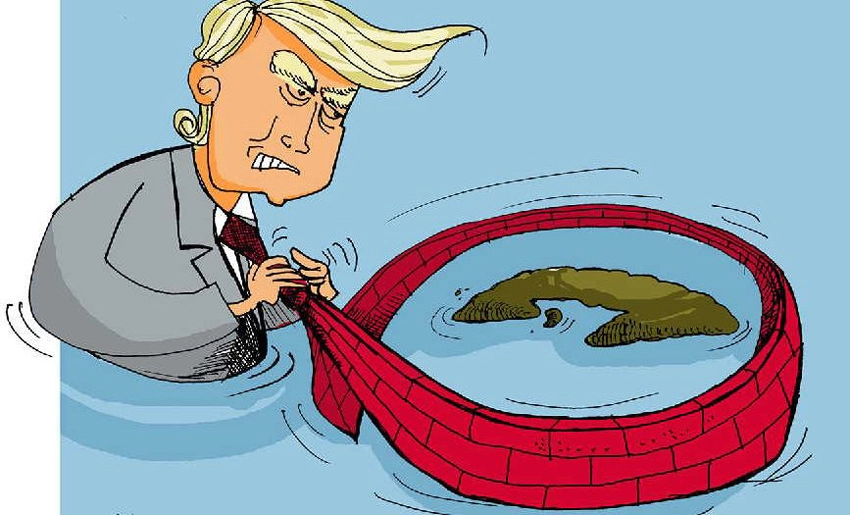
The US administration, led by Donald Trump, has deployed a new piece on its complex chessboard of aggression against Cuba. Under the supposed interest of “alleviating” a humanitarian crisis that its own sanctions have provoked. Washington is now attempting to soften its energy blockade.
According to recent statements, the Treasury and Commerce Departments will issue guidelines. To assure oil companies that they can sell fuel to private businesses on the island. Claiming that the blockade only seeks to strangle state institutions.
However, behind this announcement lies not a humanitarian intention, but a strategy of social and political fragmentation that deserves in-depth analysis.
It is a blatant contradiction that those who have designed an “oil quarantine”—by targeting ships. Pressuring traditional suppliers like Mexico, and destabilizing strategic allies like Venezuela—are now presenting themselves as facilitators of solutions.
The reality facing the Cuban people is not the product of an isolated action; it is the direct result of a maximum pressure policy that, as the United Nations has rightly warned, impacts vital sectors.
In Cuba, the state guarantees electricity for homes, fuel for ambulances, and school transportation.
The measure of “allowing” sales only to the non-state sector seeks to create a rift in national unity. By privileging small and medium-sized enterprises (SMEs) over the public sector. Washington is attempting to create an economic actor dependent on its licenses. Pretending that the Cuban economy can function in a schizophrenic fashion. With a private sector with resources and a public sector—which sustains education and universal healthcare—suffocated by the blockade.
For Cuba, this scenario presents immediate challenges regarding energy sovereignty. Cuba reaffirms that its development cannot depend on the “authorizations” of a foreign power that uses energy supply as a political pressure switch.
On the other hand, although the Cuban private sector has the legal standing to import. So the financial limitations imposed by Cuba’s inclusion on the list of state sponsors of terrorism hinder any banking transaction. Rendering these “facilities” practically meaningless for many.
Faced with this hostility, the national response remains the optimization of its own resources and the search for energy alternatives that do not involve the political capitulation demanded by figures like Marco Rubio.
Also the Trump administration’s announcement is not a gesture of goodwill. It is a tactical adjustment within a regime change strategy that has failed for decades. Cuba does not need “emergency rations” sent to circumvent its authorities. Rather the complete cessation of the unilateral coercive measures that impede the normal flow of energy and trade.
True humanitarian aid would simply be to let Cuba breathe and trade with the world without threats.
By: Daimy Peña Guillén

- Russia Schedules Launch of Reusable Space Rocket - 11 de April de 2026
- Promoting Learning with the Ludox Video Game Platform - 11 de April de 2026
- West Syndrome: Beyond Spasms - 11 de April de 2026