
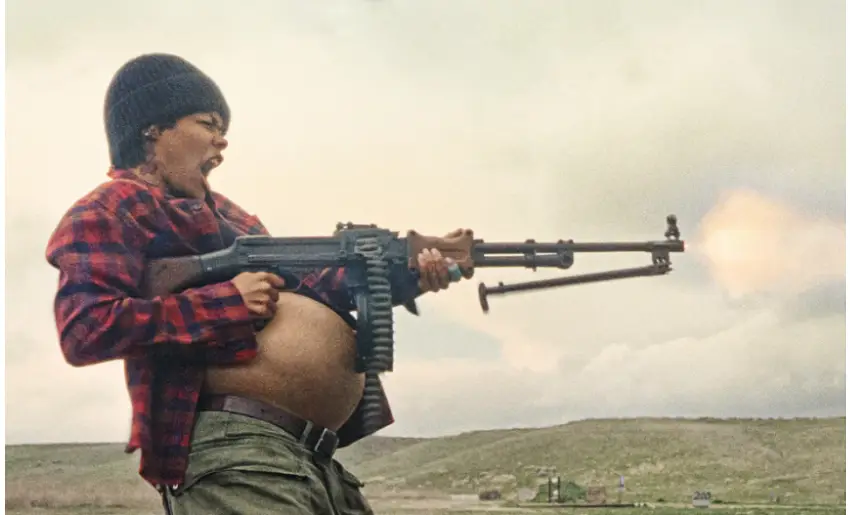
THE FOLLOWING ARTICLE CONTAINS SPOILERS FOR THE FILM ONE BATTLE AFTER ANOTHER (2025)
In public discourse, One Battle After Another (2025) has been marketed. As a film about revolution, understood as a Promethean igniter of opium. To soothe us amidst so much cynicism. Nothing could be further from the truth. In fact, I would say that the film’s political undertones are its weakest point.
One Battle After Another is the latest film by Paul Thomas Anderson. Who once again adapts (or rather, draws inspiration from) the novels of the enigmatic American writer Thomas Pynchon.
In this case, he transforms the rebellious hippies of the 60s and 70s into more stereotypical radicals. Defecting terrorist cells in the cancerous heart of United States.
We focus on the retired members of French 75, a revolutionary organization. That, between attacks, fiercely defends the violated rights of immigrants. I find the scene where Bob (Leonardo DiCaprio), our domesticated “bad man,” watches The Battle of Algiers (1966) while getting high quite comical.
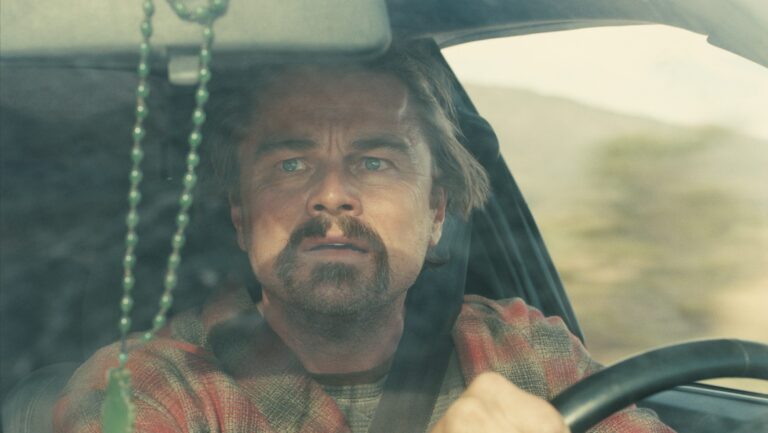
Leaving aside the way the film displays its influences and characterizes Ghetto Pat the Rocket Man (Bob’s revolutionary alias). We could compare both films to understand what I meant at the beginning.
The Battle of Algiers drew inspiration from a real historical struggle (the Algerian War of Independence). It gives us a film full of intrigue and tension, but its characters were more like devices (with few exceptions). To make us question issues of constant relevance (such as political violence, colonialism, etc.).
Thomas Anderson takes a more atomized approach. More inclined to showcase the quirks and anxieties of each of his characters, who are the driving force behind the plot, because it all revolves around a love triangle that ends badly and parental conflicts.
You only need to watch the prologue to realize the more distant, superficial, and aestheticized view of political struggles. To be clear, this isn’t inherently bad. The political issues are merely a backdrop, an excuse for the film’s true protagonist: the chase.
This is where the film shines: an elegant use of the camera that achieves great immersion and a soundtrack. Whose piano notes perfectly complement the eccentricity that pervades the entire film. This isn’t a traditional action movie, and there’s a noticeable excess of choreography in some scenes. In certain cases (like the police repression of a demonstration or a shootout), slightly breaks the spell.
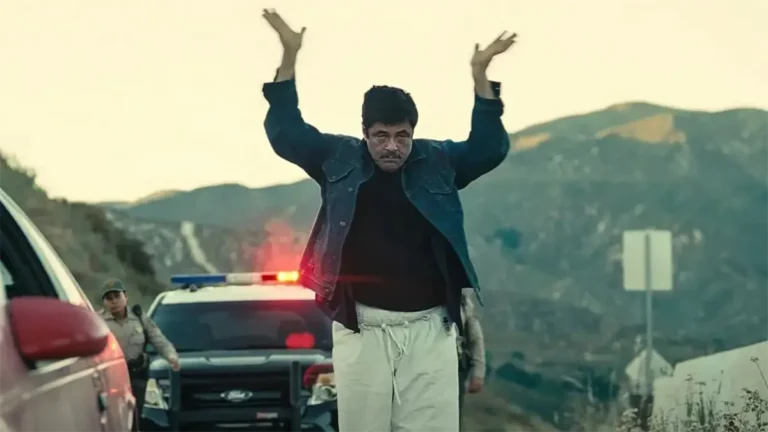
Also the performances are also a highlight of the film, with Sean Penn as ridiculous as he is menacing. DiCaprio funny but perhaps starting to be typecast. And Benicio del Toro, who for me is a walking gag amidst so many radical Americans. Considering that this man was literally Che Guevara.
Despite all this, after almost three hours of footage that don’t feel tedious at all. The excessive restraint in a work that promised an epic becomes evident. The frenetic pace becomes a double-edged sword. So that prevents the film from breathing and giving a more satisfying development to the characters, especially Charlene (Chase Infiniti).
With her cardboard political ideas, with her charismatic characters constrained by the demands of the plot, by the need to keep running, climbing, hiding. The real battle this film will face is the battle to be remembered. With each passing year, and to stand out against every older P.T. Anderson film that came before it, and against every P.T. Anderson film that follows.
By: Rolando Casals, a journalism student

- Minjus informs about the use of criminal records in Cuba and abroad - 6 de April de 2026
- Active Sedentary Lifestyle: A New Therapy Against Dementia - 6 de April de 2026
- The Antonio Guiteras Thermoelectric Power Plant is underway after its shutdown from the SEN - 6 de April de 2026