
Economic and daily life in Cuba is further strained by a new package of restrictive measures on interprovincial transportation and the worsening energy crisis. Announced as a response to the chronic fuel shortage.
In this scenario, where mobility is reduced and citizen anxiety is growing, old contradictions are exacerbated. On the one hand, the tendency to hoard basic products is emerging. On the other, on the front of financial modernization, a significant gap persists between what the law dictates and the daily practices of businesses and citizens.
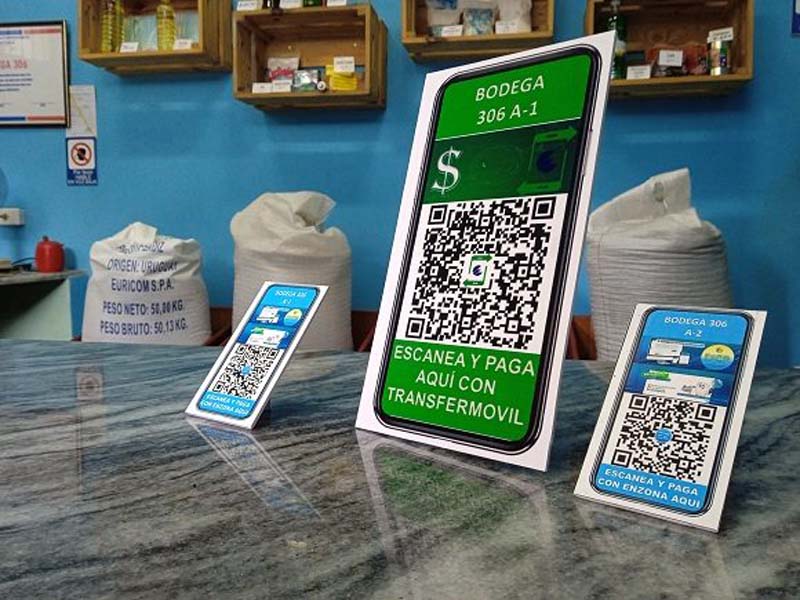
Thus, a paradox is observed: a clear law versus a diffuse application.” Cuban regulations are explicit: since May 2025, Resolution 15/2025 of the Ministry of Domestic Trade (MINCIN) has mandated the use of electronic payment methods for almost all commercial transactions. Explicitly including those of micro, small, and medium-sized enterprises (MSMEs).
According to this provision, published in the Official Gazette, transactions. Such as the purchase of food, non-food products, and supplies for businesses must be carried out via transfers, cards, or QR codes, thus becoming an alternative to the cash shortage.
However, in practice, the reality is quite different. Comments from Holguin residents consistently point to widespread resistance. Reports are growing daily that “very, very few businesses will let you pay by transfer,” or that establishments only accept this method during specific hours, “until 9:00 a.m. when the inspectors arrive.”
This refusal, according to the merchants themselves, stems from a liquidity problem. If they receive electronic money but cannot withdraw the equivalent cash from the bank for their own informal purchases or payments, the system breaks down.
Also this practice not only contravenes the MINCIN Resolution. But also Decree-Law 100/2024 on the Payment System. Which expressly prohibits setting higher prices or disadvantageous conditions for those who pay electronically.
Consequently, while the law seeks to incentivize the use of banking services. So the lack of cash in the system and operational difficulties have the opposite effect. One aspect that generates confusion is the regulation of transfer limits. Certainly, there are operational limits in place, established by the Central Bank of Cuba (BCC) and detailed by institutions such as the Bank of Credit and Commerce (BANDEC).
However, the figures colloquially mentioned (1,500 or 2,000 pesos) do not correspond to the current official limits. Which are as follows: The Central Bank of Cuba (BCC) has justified these limits as an international practice for financial control. It is crucial to clarify that these restrictions apply specifically to transfers between individuals. Transactions from personal accounts to legal entities (such as payments to a micro, small, or medium-sized enterprise) or between companies are, in theory, not subject to these same limits.
Moreover the discontent, however, is palpable. It arises, for example, when questioning the appropriateness of these limits in an inflationary context, asking: “What is 120,000 CUP today?” The frequent complaint is that, while digitalization is being promoted, these limits and the difficulties in withdrawing cash (with daily quotas that can be as low as 2,000 CUP at some branches) obstruct the normal flow of the economy.

These challenges—transportation and fuel restrictions, resistance to digital payments, and the perception of banking restrictions—are not isolated issues. On the contrary, they combine into a cocktail that erodes trust and distorts economic behavior.
Thus, the logistical uncertainty generated by the suspension of bus routes and prolonged power outages fuels the instinct to stockpile goods in the face of fears of greater shortages. At the same time, the limited practicality of electronic money for many merchants—trapped in accounts by withdrawal limits and cash scarcity—leads them to reject it, forcing the population to seek out banknotes that are also scarce. This creates a vicious cycle: less acceptance of digital payments, more demand for cash, and more pressure on the banking system.
Cuba insists on financial inclusion as a means of financial recovery and control. However, its implementation clashes with a fragile technological infrastructure, insufficient monetary liquidity, and, perhaps most complexly. A profound disconnect between the regulations and the lived reality of the economic actors who must comply with them.
Therefore, overcoming this gap requires not only control and inspection—which, according to citizen reports, is inconsistent—but also comprehensive solutions that address the practical links in the chain.
The ultimate goal must be to ensure that digitalization is a useful and seamless tool for everyone. Also not an additional burden in already difficult times.
By: Daimy Peña Guillén

- Another Mexican Ship with Aid Arrives in Havana - 28 de March de 2026
- Vandalism, a Silent Enemy in Holguin - 28 de March de 2026
- Solar Kits Illuminate Communities in the Turquino Plan - 28 de March de 2026