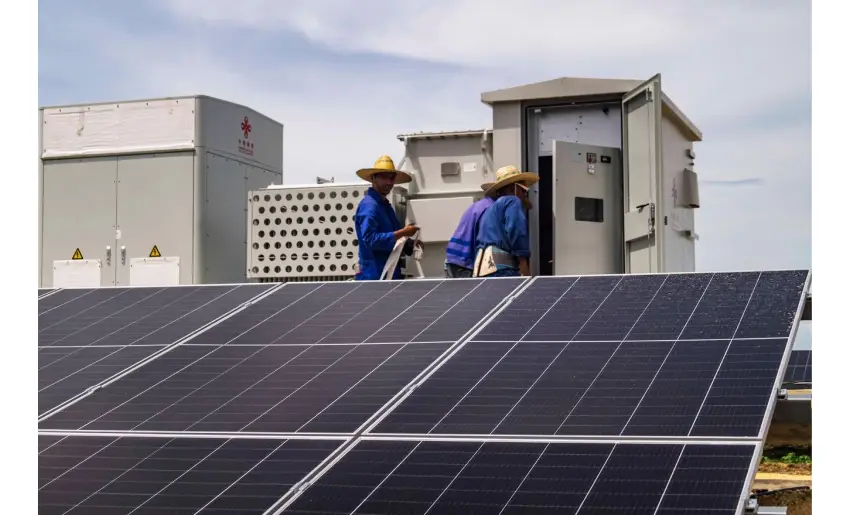
Holguin is advancing in its goal of transforming the energy landscape of eastern Cuba. Amid a national situation still tense due to fuel shortages, the province is committed to a sustained strategy. To maximize the use of solar energy, generate clean electricity, and reduce dependence on fossil fuels.
According to data from the Provincial Electric Company, 18 percent of the energy currently consumed in Holguin comes from photovoltaic solar parks (PVSPs). A figure that will continue to grow during 2026 with the commissioning of new installations distributed across several municipalities.
Energy that illuminates change.
During 2025, the Corúa, Providencia, Pilón, and La Caridad PVSPs were connected to the National Electrical System. These plants, together with other projects already operational, mean that six of the eleven planned parks are currently synchronized. Their combined capacity exceeds 87.5 megawatts (MW), with daily production levels ranging from 435 to 574 megawatt-hours (MWh). It figures represent a concrete contribution to alleviating provincial demand, estimated at more than 3,200 MWh per day.
For the province’s Director of Renewable Energy Sources, Fernando Hechavarría Pupo, the local effort is vital: “Every MW generated from the sun translates into fuel savings and autonomy. The goal is to consolidate a clean energy sector that provides stability to the electricity service.”
Investments with a solar focus.
The projects entering their final phase of execution aim to reinforce this strategy. Cueto will incorporate a 21.875 MW park, whose synchronization is scheduled for January of this year. While Serones II, El Cocal, Aguaceros, and the University of Moa complete a group of new investments with capacities ranging from 0.24 to 5 MW.
In parallel, other sites are already being prepared: Serones I (Mayarí), Varona (Banes), La Caridad (Rafael Freyre), Los Giros (Gibara), and Los Cocos (Báguanos). Initial construction and earthmoving are underway at each site, carried out by local construction companies.
“Solar generation depends on the intensity of radiation, so daily production is never uniform. However, once the eleven plan parks are install, it will cover a large part of the local demand at midday,” commented Cesar Sarmiento Ávila, head of system installation.
A decisive year.
Technical projections indicate that, by the end of 2026, Holguin will reach an installed capacity of 159.7 MW from renewable sources. With an estimated daily generation of 165 MWh. This volume would represent a savings of 35.4 tons of diesel and more than $21,000 each day.
Although the energy crisis will not disappear in the short term, the figures confirm that every investment in photovoltaic technology multiplies economic and environmental benefits. Today, the province, the second most populated territory in the country in terms of electricity customers, is responsibly embracing this challenge. Its commitment to energy represents an energy culture that involves households, businesses, and institutions.
By: Jorge Alejandro Fernández Pérez

- Cuba defeats Nicaragua 6-0 in closing friendly series - 28 de February de 2026
- Print and Circulation Adjustments for the Written Press - 28 de February de 2026
- Israel and the US bomb Tehran - 28 de February de 2026