

Mathematics, algebra, gematria, arithmetic, and numerology all share the study of numbers. But when we talk about the number 13, some people experience a phobia due to its association with bloodshed and bad luck throughout human history.
Although bad luck is the excuse of the unsuccessful, as the Chilean poet Pablo Neruda said. The association of 13 with negative connotations in many cultures, primarily linked to religión. It is triggered when the 13th falls on a Tuesday or Friday.
Today is Tuesday 13th, and it’s not only in Cuba that it’s considered an unlucky day. It’s also traditionally observed in the cultures of countries like Greece, Spain, Uruguay, Paraguay, the Dominican Republic, Argentina, Chile, Peru, Venezuela, Colombia, and Ecuador, among others.
Although it may seem like just a popular belief, the bad reputation of the number 13 has ancient roots. In the Bible, for example, the Last Supper was attended by 13 people. With Judas, the apostle who betrayed Jesus, being the last to sit at the table. This is compounded by the belief that Jesus was crucified on Friday 13th. In which has reinforced the idea that this number brings misfortune.
Another detail that fuels superstition appears in chapter 13 of Revelation, where the Antichrist is first mentioned. “And I stood upon the sand of the sea, and saw a beast rise up out of the sea. Having seven heads and ten horns, and upon his horns ten diadems, and upon his heads the name of blasphemy.”
From another perspective, in the tarot, card number 13 represents Death. A figure that, although it symbolizes transformation, is often interpreted as a bad omen. Furthermore, in popular culture, especially in dream interpretation charts used for gambling, the number 13 is known as “the jinx,” meaning bad luck at its worst.
The combination of the number 13 with Tuesday also has its explanation. In Roman mythology, Tuesday was dedicated to Mars, the god of war. He was associated with violence, conflict, and impulsiveness. Therefore, this day was not considered favorable for making important decisions or implementing changes.
Some historians even link the fear of this day to the fall of Constantinople. A tragic event for the Christian world, which occurred on Tuesday, May 29th, 1453. This event reinforced the idea that Tuesdays were days fraught with misfortune and loss.
Those who believe in these traditions maintain that there are a number of things that should not be done on Tuesday 13th. As they could bring negative consequences. Among the most common are:
It is suggested not to get married, sign documents, or start new projects on this day. The reason is that these commitments might not prosper or could bring complications in the future.
It is also recommended not to start a new job or make investments, as the day’s energy is not conducive to beginning new cycles.
Another common piece of advice is to avoid long trips or embarking on new adventures. It is believed that doing so could result in accidents or unforeseen situations. The same applies to moving, as changing houses on Tuesday 13th could bring family conflicts, financial losses, or even illness.
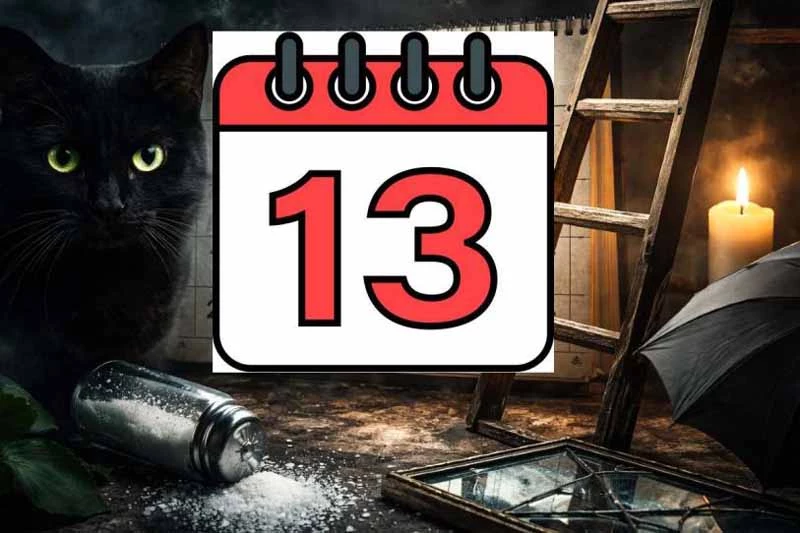
According to reports such as the one from the Europa Press news agency, there are other recommendations that are also observed on Tuesday 13th. For example, avoid cutting your hair or nails, do not lend or borrow money, do not walk on cracks, and avoid wearing colors like green or yellow. Also as they are associated with unfavorable energies.
All these practices are related to ancient rituals or beliefs that, although they may seem exaggerated today, are still followed by many people as a precautionary measure.
“On Tuesday 13th, neither marry nor embark on a journey” is a well-known saying in Spanish-speaking countries. The fear of Tuesdays that fall on this number is a superstition that some believe, others ridicule, and many simply ignore.
The 13th is by no means the only day that carries the stigma of bad luck. In Italy, for example, Friday 17th it’s considered unlucky: this superstition again comes from Roman culture. Since in Roman numerals it’s written as XVII, which, rearranging the letters, can be read as vixi (Latin for “I lived,” implying death).
In Japan and China, the number four is generally considered a forbidden number. So as its original pronunciation is shi, which also means death. The phobia of four is such that the Japanese created an alternative pronunciation for the number, which came to be pronounced yon. And if we continue to look at all the dark episodes in every culture of the world, probably no day of the month would be free of blame.

- Fernández: Our Most International Pianist - 20 de February de 2026
- The Psychology of Love in Couples - 16 de February de 2026
- Love, the Fuel of Our Lives - 14 de February de 2026