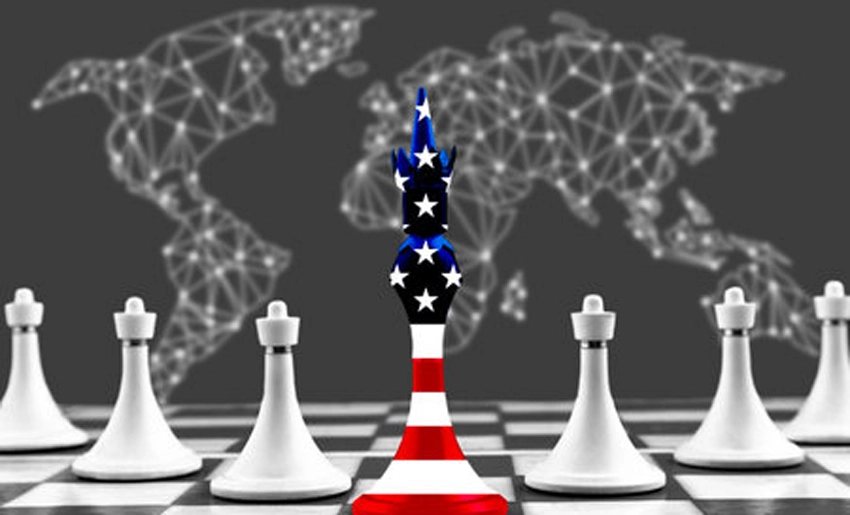
If we imagine the international stage as a complex chessboard, we see that the major powers execute their moves with cold strategy. While the nations of the Global South defend, with intelligence and dignity, their right to exist as players and not as mere squares to be dominated.
The current game in Our America has one square ablaze: Venezuela, and its development defines the balance of the entire hemisphere.
In this game, the United States stands as the player who seeks to dictate the rules. Moving its pieces with a mixture of brute force and economic pressure. Its most recent move—a military intervention under already worn-out pretexts—captures material on the board. But completely destabilizes the game. However, this action is not checkmate. Rather, it is a risky move that ignores the resilience of the people and the complexity of the region.
Faced with this offensive, Russia and China answer with far-reaching moves and strategic depth. The first, exercising its role in the Security Council and ratifying alliances, defends international law with firm words. The second, through investments and trade ties, consolidates a presence that challenges the traditional economic monopoly. Both defend, from their respective positions, a multipolar order where their allied pawns. In reality, sovereign nations—are not sacrificed.
The Latin American pieces, for their part, demonstrate that the game is not bipolar. Mexico, with an L-shaped move of principle and pragmatism, condemns the intervention and raises its voice for self-determination, offering dialogue. Cuba, far from being a passive pawn, is an example of resistance that, despite economic strangulation and new threats to its energy, maintains its steadfastness and unwavering solidarity. However, the Venezuelan people occupy the center of this drama.
But Venezuela is not just a “critical pawn,” but an entire society that for years has endured a ruthless siege and now faces direct occupation. Their future should not be decided in Washington, Moscow, or Beijing, but in Caracas. Through sovereign dialogue and the will of the people.
Therefore, the next crucial move is not only diplomatic, but moral. The world is watching to see whether the law of the strongest prevails or the right of peoples to choose their own destiny. True victory on this chessboard will not consist of capturing the opposing King. But in forcing a new game, with fairer rules. where sovereignty and cooperation are the true principles of the movement.
Latin America and the Caribbean, with their history of struggles, continue to demonstrate that they refuse to be anyone’s backyard, but rather the common home of all. The game continues, and dignity, for now, is not in check.
By: Daimy Peña Guillén

- Divep Company in Holguin Boosts Industrial Production Plans - 27 de February de 2026
- A Sustainable Approach to Nature Preservation in Holguin - 27 de February de 2026
- Fear in the Heart of Cuba - 27 de February de 2026