
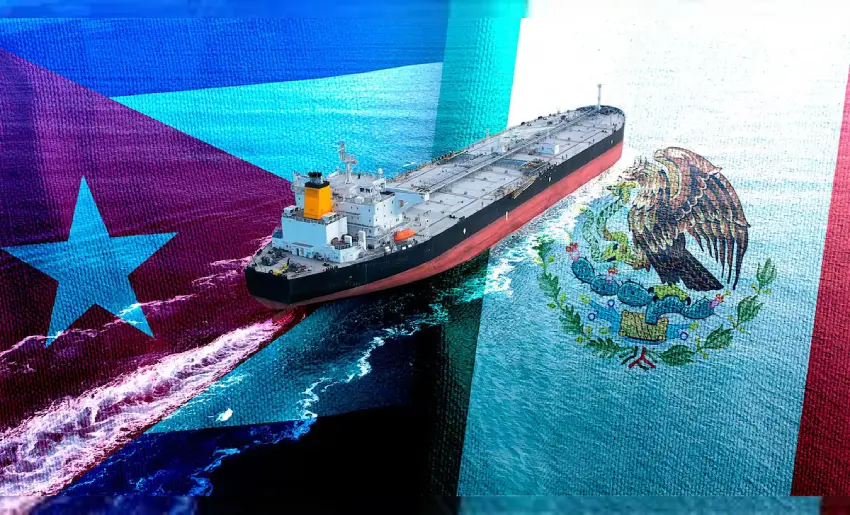
At a critical moment for Latin American sovereignty, marked by US aggression against Venezuela and the intensification of the economic blockade against Cuba. The Republic of Mexico has reaffirmed its tradition of solidarity and non-intervention through concrete actions.
The supply of oil and refined products to the island of Cuba, described by President Claudia Sheinbaum. As part of a historic foreign policy and humanitarian aid effort, has become vital support for the Cuban people in the face of an energy crisis deliberately exacerbated by Washington.
Moreover this cooperation, which dates back decades and has been sustained by Mexican governments of varying political orientations. It demonstrates that it is possible to build relationships. Based on mutual respect and counteract hegemonic pressures in the region.
President Sheinbaum has been clear in explaining the principles governing this bilateral relationship. The shipments are made “within a legal framework, as a sovereign nation” and continue a long-standing state policy. From the outset, Mexico was the only country to oppose the blockade against Cuba in the OAS. A principled position it has maintained throughout the years.
Energy cooperation has deep roots. Historical examples include a $350 million investment in 1994 to modernize the Cienfuegos refinery. Also technical assistance agreements between Pemex and the Cuban state oil company CUPET. And the forgiveness of 70% of Cuba’s historical debt to Pemex during President Peña Nieto’s administration. Restructuring the remainder to promote trade.
In the current context, following the capture of Venezuelan President Nicolás Maduro by U.S. forces and the control the U.S. exerts over Venezuelan oil exports. Mexican support takes on an even more crucial dimension. Data from the firm Kpler confirms that in 2025 Mexico became Cuba’s main supplier of crude oil. Accounting for 44% of imports (an average of 12,284 barrels per day), surpassing Venezuela (34%) for the first time.
Reports from Pemex to the U.S. Securities and Exchange Commission (SEC) detail volumes of 17,200 barrels of crude oil per day between January and September 2025. Meanwhile, the administration of President Donald Trump has made clear its objective of forcing “change” in Cuba. Using economic and energy strangulation as its primary tool. The blockade, intensified in recent years, is the main cause of the shortages suffered by the Cuban people. Limiting access to fuel, spare parts, investments, and technology necessary for the energy sector.
The impact of this hostile policy is tangible in daily life, pushing the electrical system to its limits. In early January 2026, Cuba registered its largest power generation deficit of the year. With outages exceeding 1,800 MW, leaving millions of people with prolonged blackouts.
Furthermore, the system, marked by years of insufficient investment and maintenance—greatly hampered by the embargo—is critically dependent on imported fuel.
Added to this is the calculated migratory pressure. Analysts like Pavel Vidal warn that a total collapse on the island could unleash a humanitarian and migration crisis of unmanageable proportions, just 150 km from Florida. Paradoxically, the U.S. simultaneously implements policies, such as exorbitant visa fees for Cubans. That punish the Cuban people and exacerbate their difficulties.
Faced with this offensive, Mexican solidarity serves as a bulwark. The Sheinbaum administration has faced direct pressure from US congressmen. Including threats to use the renegotiation of the United States-Mexico-Canada Agreement (USMCA) as leverage to cut off supplies. Even so, it has maintained its stance. Defending the right to a sovereign foreign policy and reminding Washington of its own responsibilities. Such as the illegal trafficking of weapons into Mexico.
Energy dependence exposes a strategic vulnerability for Cuba. But it also underscores the importance of regional unity and cooperation. Mexico’s support, while vital, must be framed within Cuba’s broader efforts to advance toward greater energy sovereignty.
In this context, the challenges are enormous, but work is underway on multiple fronts. These include accelerating the renewable energy program. Maximizing the contribution of solar, wind, and other energy sources to diversify the energy mix. Prioritizing the maintenance and efficiency of thermoelectric plants. Despite the shortage of parts and lubricants imposed by the US embargo.
Mexican oil is today “Cuba’s burning energy candle,” in the words of analysts. It is more than fuel. It is a symbol that solidarity and internationalism remain alive in Our America. It demonstrates that, in the face of coercion and force, solidarity persists.
Also the battle to maintain the electricity supply in Cuba is part of the larger struggle for a just international order. In where any country has the right to economically strangle another to subdue its sovereign will. In this fight, Mexico’s principles and concrete actions illuminate the path.
By: Daimy Peña Guillén

- Russia Schedules Launch of Reusable Space Rocket - 11 de April de 2026
- Promoting Learning with the Ludox Video Game Platform - 11 de April de 2026
- West Syndrome: Beyond Spasms - 11 de April de 2026