
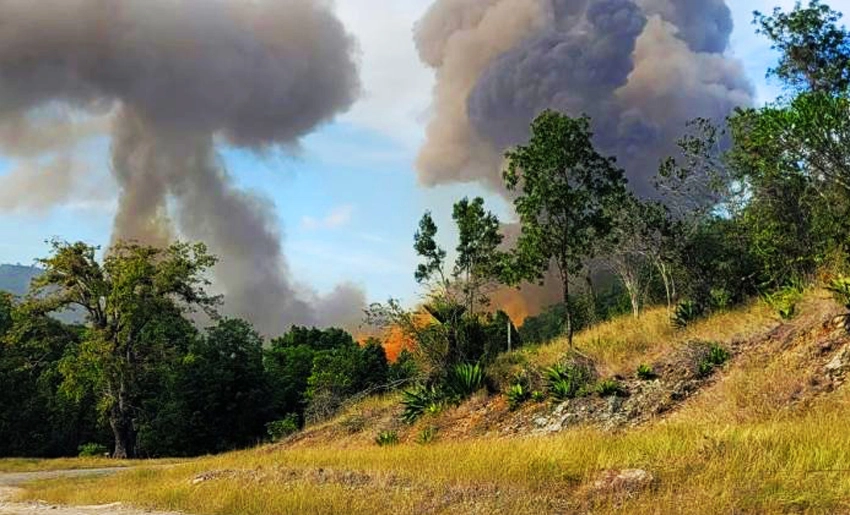
The early morning of January 7th, 2025, left a scar on the landscape and soul of this community in Holguin province. Today, a year later, the wind that descends from the hills steeped in history brings a different kind of silence. One that prevails over the memory of the explosions in Melones. It is not the silence of oblivion, but the silence of a wound that throbs in the memory of a people. Honoring the thirteen sons of the Fatherland who gave their lives in the line of duty.
That early morning, a fire at a military installation triggered a series of explosions that shook the earth and startled the entire town awake. The news, contained and precise. First arrived through the Official Report of the Ministry of the Revolutionary Armed Forces (MINFAR).
Moreover the priority, from the very first minute, was the protection of the people. 494 residents of Melones and surrounding areas were evacuated swiftly and in an orderly way. An operation where discipline and solidarity were interwoven to prevent further loss of life.
But as flames lit up the sky and explosions followed one after another, thirteen faces remained shrouded in uncertainty. Two majors, two second sub-officers, and nine soldiers, all missing in the line of duty. Their names, later released by the Ministry of the Revolutionary Armed Forces (MINFAR). Ceased to be mere statistics and became a source of grief for families and the nation.
The following days were filled with suppressed anguish and tenacious hope. A high-level commission, comprised of representatives from the Communist Party of Cuba, the government, MINFAR, and the Ministry of the Interior, was established at the site. The search and rescue efforts encountered a devastating reality: collapsed structures, gas leaks, and a constant risk of further collapse. The terrain itself had become an enemy. The specialists, their hearts in their mouths, worked tirelessly to find any sign of life.
Science, experience, and the stark reality of the events led to the most painful conclusion. On January 15th, the Ministry of the Revolutionary Armed Forces (MINFAR) informed the Cuban people of what many already suspected: the thirteen valiant soldiers had perished in the accident. The probable cause, determined after a thorough investigation, was an electrical failure due to a short circuit. Also the news was not just a report; it was a blow that resonated throughout the island.
A year later, Melones stands as an example of resilience. The evacuated houses have been rebuilt, and daily life has return to normal. But the community remains the guardian of their memory.
The mourning for the thirteen soldiers has become intertwined with pride in their sacrifice. In Holguin, a province steeped in combat traditions, sacrifice in the line of duty is a pain that transforms into profound respect. The families, in their dignified and private grief, have received the enduring recognition of the revolutionary institution to which their loved ones belonged.
Futhermore the tragedy prompted a thorough review of safety protocols at similar facilities across the country. The technical analysis of the accident served not to assign blame, but to strengthen prevention. The lesson learned at too high a price is that the protection of human life—that of the guards and that of the surrounding community—is the absolute principle.
Today, at the site of the tragedy, a solemn silence speaks louder than words. There is no visible monument yet, but the memory is etch in the conscience of every Cuban. The names of those thirteen soldiers—the majors, the non-commissioned officers, the young privates—are inscribed on the list of those who gave everything for the security of the nation.
One year after that early morning that split the history of Melones in two, the tribute is not just an act of remembrance. It is a reaffirmation that, in the face of adversity, unity, revolutionary discipline, and the protection of the people remain the unshakeable pillars. Life, with its stubborn force, continues in this corner of Holguin. But it beats to the rhythm of a heart that does not forget its heroes.
By: Daimy Peña Guillén

- Holguin Hosts National Celebration of Children’s Center Anniversary - 10 de April de 2026
- Blockade Affects Care for High-Risk Pregnant Women in Holguin - 10 de April de 2026
- Cuba is not subject to the dictates of the United States, Díaz-Canel tells NBC News - 10 de April de 2026