
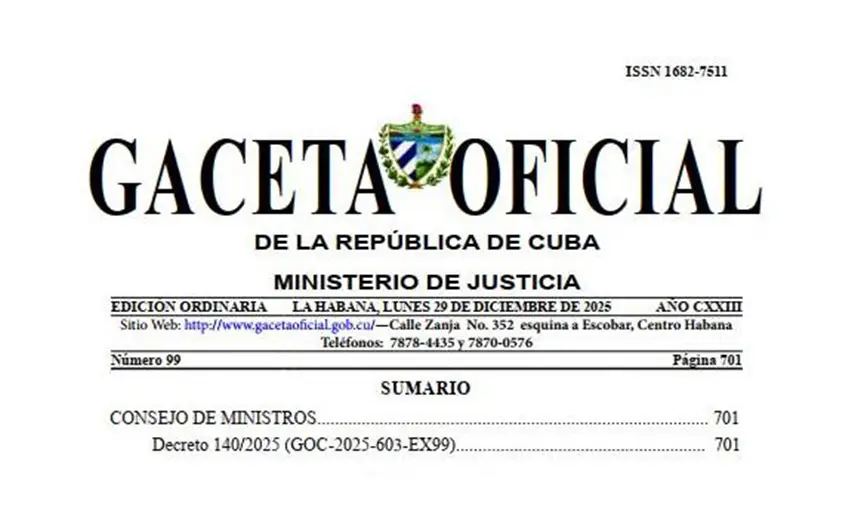
Cuba will implement a process of extraordinary administrative, economic, and social scope during the first quarter of 2026. This process consists of the gradual decentralization of powers and the transfer of resources to municipalities. Exceptionally, to provinces, by agencies of the Central State Administration and other national state bodies and institutions.
Details of its objectives, principles, and rules are contain in Decree 140/2025 of the Council of Ministers. Which will enter into force 90 days after its publication in Extraordinary Official Gazette No. 99 of December 29th of the previous year.
The process is governed by the provisions of the Constitution of the Republic of Cuba, the laws, and other regulatory provisions. It consists of the transfer of functions, powers, activities, responsibilities, structures, and resources. From the system of entities served by agencies and bodies to municipalities and, exceptionally, to provinces.
Moreover according to one of its articles, the essential objective of the measure is to implement municipal autonomy by distributing Powers. Among the different levels of government, contributing to the country’s comprehensive, harmonious, and sustainable development.
This must necessarily be accompanied by the structures, personnel, and financial and material resources. Directly linked to the transferred activities and services, ensuring their continuity and efficiency. The process is guided by principles of gradualism. So as it is implemented in stages, progressively, according to criteria that allow for a clear. And appropriate allocation of powers and resource transfers to the territories.
It is also characterized by flexibility and heterogeneity. Allowing for adaptations and adjustments based on the characteristics of each territory and in pursuit of efficient. Inclusive public management aligned with the needs of the local population.
Subsidiarity is also taken into account. Based on the principle that decisions made at the local level. Closer to the citizen, are those that cannot be made at the central level. Recognizing the capacity and right of local administrative bodies of People’s Power to fulfill their responsibilities.
Other principles included in the decree are equity and comprehensive human development. Given that decentralization must consider its impact on the general well-being and quality of life of individuals. Based on economic growth and citizen participation in government management.
The process is definitive and binding, as once concluded it is irrevocable, cannot be subject to subsequent changes. It constitutes an effective obligation for the competent bodies and agencies, the provision states.
Sectors or activities are excluded from the decentralization process:
- a) National defense and security;
- b) Foreign relations;
- c) Monetary, exchange rate, financial, tax, and banking policies;
- d) Public infrastructure of national scope and interest;
- e) Territorial planning and urban development;
- f) Aviation and merchant marine;
- g) Telecommunications and radio spectrum;
- h) Water;
- i) non-renewable natural resources;
- j) hydrocarbon refining;
- k) biodiversity;
- l) genetic heritage; and
- m) others as determined by the Council of Ministers.
A temporary national commission, of a governmental nature and chaired by a deputy prime minister. It will be responsible for directing, promoting, and monitoring the development of the decentralization process, the decree itself specifies.
With information from CNA

- The Advertising Business Promotes Agricultural Self-Sufficiency - 9 de April de 2026
- School for Children with Autism Strengthens Family Ties - 9 de April de 2026
- Holpes Recognized for Business Achievements in Holguin - 9 de April de 2026