
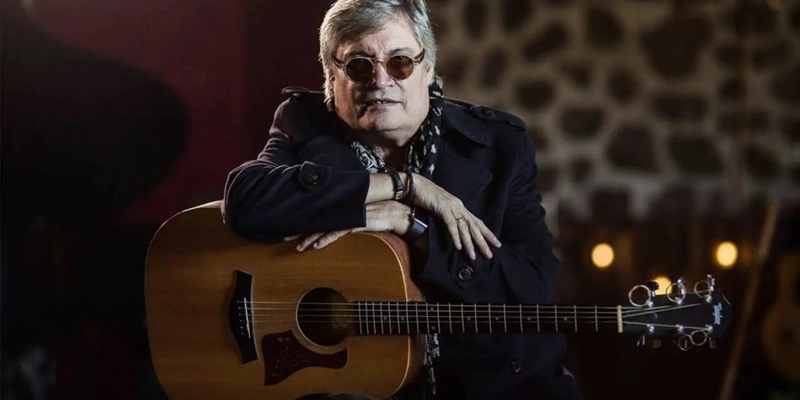
“The songs are very intellectual,” a woman told me during a concert Amaury Pérez Vidal gave at the Eddy Suñol Theater in 2000. “But the lyrics of his songs are very beautiful,” added the audience member from Holguin.
Danilo, a Peruvian tourist, also loved him and highlighted the timbre of his troubadour voice. Which filled the main theater in the city of Holguin during that performance.
Those who know him well praise him for the great humanitarian gestures he has been able to defend. Always in the name of the most just causes when it comes to loving one’s neighbor.
Born on December 26th, 1953, he has been a leading figure in the Nueva Trova movement. His songs have affinities with jazz and pop, some blended with rock music. Also his most recent work is rooted in the romantic ballad style.
He is one of the most important Cuban composers of the second half of the 20th century. But he has also distinguished himself as a record producer, writer, screenwriter, and director and host of radio, live shows, and television programs.
In 1969, he composed his first songs, and after meeting Silvio Rodríguez, Pablo Milanés, Sara González, and Noel Nicola in 1971, his compositions became defined within the Nueva Trova style. During this period, his work included setting poems by poets. Such as José Martí, Nicolás Guillén, Miguel Hernández, and Machado, among others, to music.
He began his artistic career in 1972 with a concert at the National Union of Writers and Artists of Cuba (UNEAC). At a gathering with poets, he premiered works with texts by Nicolás Guillén, Otto Fernández, Fayad Jamís, Pedro de Oráa, and Luis Marré. As well as by poets from various Latin American countries, including Julio Cortázar, Mario Benedetti, and Eduardo Galeano.
His charisma has placed him among the most popular Cuban musicians. A popularity that has grown with his innovative approach to performing songs with powerful lyrics. Rich in imagery and metaphors, which he executes with great professionalism.
In 1976, he won significant recognition at the Dresden Pop Music Festival in Germany. He toured Spain, Poland, and Bulgaria with the ICAIC’s Grupo de Experimentación Sonora (Sound Experimentation Group), Pablo Milanés, and Sara González.
He also toured Spain, Poland, and Bulgaria. In Spain, he associated with some of the most important figures in Cuban music. Such as Joan Manuel Serrat, Pi de la Serra, María del Mar Bonet. Lluís Llach, Miguel Ríos, Luis Eduardo Aute, Ana Belén, Víctor Manuel, and Teddy Bautista.
In 1978, he worked with the group Síntesis, with whom he participated in the Varadero ’81 Song Festival. Later toured Venezuela, Mexico, and Spain.
His songs, with lyrics by José Martí, were recorded by the National Symphony Orchestra of Cuba. Conducted by Armando Guerra, with neo-baroque arrangements by Mike Porcel.
When he began singing, his role model was Silvio Rodríguez, and he has never been able to distinguish whether he is more of a songwriter than a performer.
Some said that Amaury sang very badly, and this gradually led him to believe that he could be a better songwriter than performer. Then came his first international tours and reviews that noted his warm, sweet, and pleasant voice. “I realized that perhaps, outside of the conventional Hispanic patterns, there were others. Where a booming voice, a gigantic range, a clear voice, perfect tremolo, and perfect vibrato weren’t required,” the troubadour once confessed.
“In other words, there was also a way of singing, nothing exceptional, but capable of working and serving me well… I began to take interpretation seriously, to work on it, not like Caruso, but with careful intention. I write songs within my vocal range; I know the limits of my register, and I’m happy with how I sing because I do it the way I like to hear others sing,” said the troubadour, who was reaching his professional limits at that time.
Regarding the influences on his creations, Amaury says: “Influences are a curious thing. I’ve felt many, and I continue to feel them. It’s just that they’re less well-known now. Silvio was a magnet.”
“Of my generation in the Nueva Canción movement, no one escaped its influence. So strong that some, over time, were able to break free and others couldn’t. Then came Serrat, who practically defined my current work on stage. Until then, I was just a kid who only aspired to sit with my guitar and sing.”
“After Serrat and seeing the possibilities that stage offered, also for Nueva Canción (New Song), I felt captivated. I observed how the resources of body movement could resonate with the spirit and produce a more transcendent performance.”
From that concept came the influence. It wasn’t so much the impact of his songs. Although that later became apparent, since I was already familiar with his repertoire and it hadn’t affected me that deeply.
This composer and performer, with an open attitude toward all aspects of creation, readily uses rock, ballads, and disco. Because, he believes, it’s important to separate the chaff and find the authentic essence of those styles. He doesn’t rule out The Beatles, and later James Taylor, Art Garfunkel, Christopher Cross, Barry Manilow. Joan Manuel Serrat, and Nacha Guevara in his stage presence, or recording an álbum. Like Aguas (Waters), with jazz-rock arrangements, feeling, pop, and so many other influences that he doesn’t deny.
But it’s not just music and musicians that fall within Pérez Vidal’s sphere of interest. There are also, among many others, poets such as Federico García Lorca, Rubén Darío. César Vallejo, Pablo Neruda, Augusto Roa Bastos. Gabriela Mistral, Dulce María Loynaz, and the great José Martí.
His works have been recorded by Marco Antonio Muñiz, Lucecita Benítez, Sheena Easton. Mercedes Sosa, Nacha Guevara, Danny Rivera, Ana Belén, Alfredo Sadel. Tania Libertad, Cheo Feliciano, Guadalupe Pineda, Alina Sánchez. Sara González, Omara Portuondo, and Beatriz Márquez, among others.
In 1979, with Ricardo Martínez (Eddy), he formed his first backing group. Later he founded another band, which at different times included José Novás (piano), Frank Rubio (electric bass), Conrado García (drums), Mario Romeu Jr. (guitar), and Manolo González (director and keyboards).
In film, he composed the music for the film *Hombres del mar* (Men of the Sea), directed by Manuel Herrera. *Isla de la Juventud* (Island of Youth), directed by Juan Carlos Tabío. For Cuban Television, he composed the themes for *Mañana es domingo* (Tomorrow is Sunday) and the theme for the series *Hasta el último aliento* (Until the Last Breath), directed by Vicente González Castro. *Muy personal* (Very Personal) with Amaury Pérez, directed by Joel Valdés; and *Con dos que se quieran* (With Two Who Love Each Other), which he hosted.
In 1995, sponsored by UNICEF, he recorded the song *El escaramujo* (The Rosehip), by Silvio Rodríguez. Featuring Luis Eduardo Aute, Vicente Feliú, Anabell López, Carmen Flores, and Silvio Rodríguez himself. That same year, he presented his Christmas Concert at the National Theater of Cuba.
In late 1990, he began recording an album of songs, with lyrics by Dulce María Loynaz. Which would be called Eternidad (Eternity). He also began recording his new album, initially titled De amor (Of Love), but later renamed Equilibrio (Balance).

He sang the Prayer to Our Lady of Charity of El Cobre during the mass celebrated by John Paul II during his visit to Havana on January 25th, 1998. In 1998, he traveled to Spain to present his album Amor difícil (Difficult Love) at the Manuel de Falla Hall of the General Society of Authors and Publishers of Spain.
With the arrival of the 21st century, he continued producing new albums. Among which Balance stands out, encompassing the blues genre. Solo en septiembre (Only in September), an album with multiple musical facets. Algo en común (Something in Common), where he ventured successfully into the salsa genre.
In 2003, he released the album Trovador (Troubadour), a collaboration with Silvio Rodríguez. In 2004, the album was promoted throughout the Americas and Spain. On December 31st, 2003, he was awarded the Félix Varela Order, Cuba’s highest official cultural honor, by Fidel Castro.
He participated in the concert “Misa Cubana a la Virgen del Cobre” (Cuban Mass to Our Lady of Charity of El Cobre) at the Basilica of Santa Maria in Trastevere, Rome, Italy. Also to celebrate the 70th anniversary of the establishment of relations between Cuba and the Vatican.
In 2006, the album “Los Dúos” (The Duets) was released. A compilation of songs he has performed with some of the most important Cuban and Latin American singers.
In November 2007, he joined the celebrations for the 35th anniversary of the Nueva Trova movement with several concerts. Including performances by Silvio Rodríguez, Vicente Feliú, Sara González, and Pablo Milanés.
In September 2009, he organized and participated in the Peace Without Borders Concert, held in Havana’s Plaza de la Revolución, which drew over a million spectators. He sang two of his own well-known songs: “Hacerte venir” and “Amor difícil.”
Bardo is the name of the album he released in November 2009, which also included a DVD and contains 13 tracks. Among them “Yo quería cantar,” “Algo de mujer,” and “Que me quiera.”
In 2024, a new album, titled Amaury Sinfónico, was released, featuring choral director, arranger, and music producer Beatriz Corona as musical director. It was evaluated as a bold album, conceived from concert music, but meeting all the conditions
The musicians of the National Symphony Orchestra of Cuba participated, along with renowned Cuban personalities. Such as Silvio Rodríguez, Ernán López Nussa, Rey Guerra, and Beatriz Corona herself. The album was released by the Colibrí record label and Fontanar Producciones.
On December 29th, 2025, he was awarded the National Music Prize. A great recognition for this great singer who has consistently championed love for his homeland, social justice, and human and religious values through his music and his work in Cuban media.

- The war against Iran: the collapse of the US dollar? - 28 de March de 2026
- The US dollar remains stable, and a Spanish company is authorized to send remittances to Cuba - 26 de March de 2026
- The Great Miguels of Spanish Literature - 24 de March de 2026