
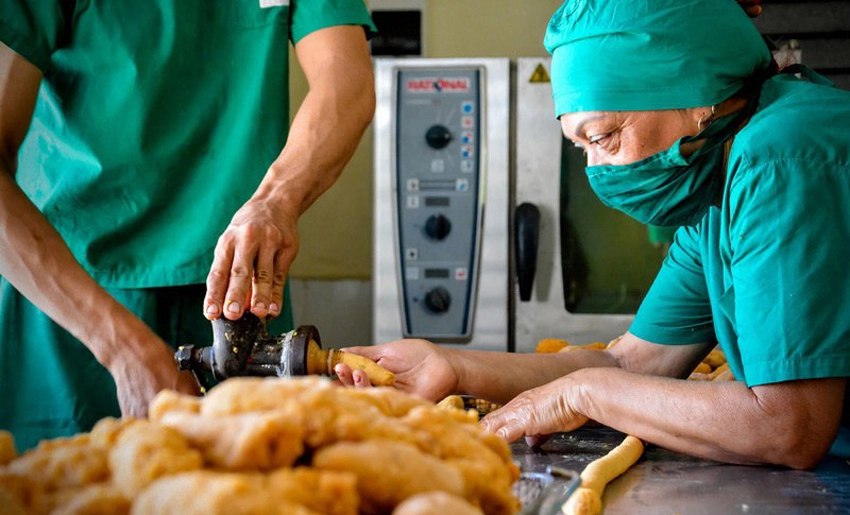
The Food Production and Distribution Company (Numa in the Spanish acronym) in Holguin province is promoting a range of cooperative productions. The result of commercial partnerships with state institutions and new management models. Aimed at expanding its offerings to the population.
By establishing links with more than 25 entities, the company maintains operational key production lines. In which these entities contribute raw materials. While Numa provides human resources, its brand, processing equipment, and facilities. Explained Kirenia Balada Peña, its director, to CNA.
With the implementation of this strategy, vital amidst the country’s complex economic situation. Where access to resources on the international market to maintain supply is costly. The company is producing cookies, noodles, macaroni, ice cream, candies, and preserves.
Moreover the prices set aim to remain affordable for consumers. Taking into account the product’s cost structure and the profit margin for each party. This is achieved in the communities of Urbano Noris and Rafael Freyre through the sale of ice cream. Also is being promoted in Gibara and the town of Piedra Blanca, in the municipal capital.
In Moa, a cooperative scheme is also in place in which the industry receives a percentage of flour at a reduced Price. Destined for various processing centers used in the production of noodles and cookies. Eighty percent of these products are sold to the public, and the remainder goes to the partner.
Among the entities with which Numa establishes these types of relationships are the Inejiro Asanuma Spinning Mill (Gihilan), the Nicarotec Services Company, and the micro, small, and medium-sized enterprises (MSMEs) Triticum and Frena Conmigo. Thus strengthening ties with the private sector.
Balada Peña adds that these partnerships are beneficial for solving the entity’s problems through technological innovation. As in the case of the recovery of old equipment with the 60th Anniversary of the October Revolution Company. The state-owned micro, small, and medium-sized enterprise (MSME) Tauba Holmotor, and the Banes Cylinder Factory.
The cultivation of land for self-sufficiency is one of the policies emphasized by the Cuban government. Also to increase agricultural activity in each locality and workplace. Thus contributing to the territory’s self-sufficiency. Numa carries out this task through work on a farm and several orchards and plots.
With information from CNA

- Another Mexican Ship with Aid Arrives in Havana - 28 de March de 2026
- Vandalism, a Silent Enemy in Holguin - 28 de March de 2026
- Solar Kits Illuminate Communities in the Turquino Plan - 28 de March de 2026