
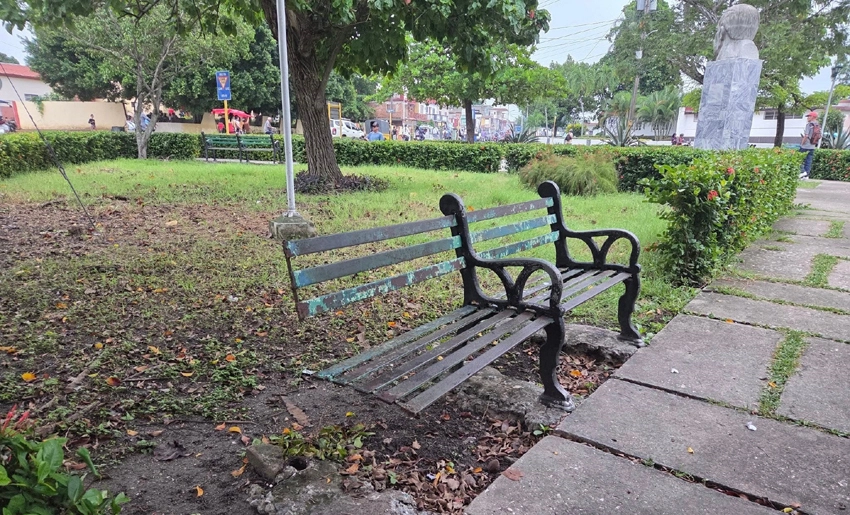
Holguin, a city proud of its identity, has become an example of the Broken Window Syndrome—which posits that visible signs of antisocial behavior create an urban environment that fosters crime and disorder.
The “broken window” metaphor emerged from environmental criminology, proposed in 1982 by criminologists James Q. Wilson and George L. Kelling. Based on a social experiment by psychologist Philip Zimbardo in 1969. This concept transcends its origin to become a powerful tool for social analysis.
It suggests that visible disorder and unattended deterioration in public spaces can normalize transgression and gradually erode the bonds of community. This approach, far from being a mere theoretical import. Resonates with concrete realities and offers an opportunity to evaluate and strengthen local development policies.
In Holguin, the City of Parks, the vitality of its public spaces is an essential component of its identity. However, as reports and the work of institutions themselves reveal. These emblematic sites face challenges: acts of vandalism that damage benches and railings, the theft of metal parts, and the accumulation of garbage in some areas.
Moreover these are symptoms of a complex phenomenon that cannot be attributed to a single cause. But rather to a combination of factors where material limitations, social dynamics, and the need to improve management and participation mechanisms interact.
Attributing this situation solely to a loss of values is insufficient. A critical analysis must consider structural and institutional factors that have created the breeding ground for this dynamic.
Moreover there is a certain degree of institutional neglect and costly “savings.” A key factor identified is the elimination of the park attendant position in most parks due to budget constraints. This has left the city’s public assets in a vulnerable state. This presents an economic contradiction, since the savings in salaries can generate much higher expenses for replacing and repairing the damage.
The responses are fragmented and ineffective. When citizens report problems to institutions like the Municipal Directorate of Community Services, they fail to generate solutions. Although there are specific investments to repair parks in local councils, these seem insufficient given the magnitude of the problem. The existence of a strict legal framework—which can even classify these acts as sabotage. So contrasts sharply with its ineffective application in prevention and daily control.
Faced with this reality, the response in the province, as explained by the delegate of the Institute of Territorial and Urban Planning (Inotu), César Paterson Rodríguez, is a comprehensive and proactive habitat development strategy.
Also the programs being implemented recognize that the best way to prevent deterioration is to address its root causes. This translates into the repair and creation of recreational areas, technical analysis of housing, improved sanitation. Crucially, the elimination of illegal construction and the relocation of families in at-risk areas.
These actions, part of the Cuban State’s housing and land-use planning policy, prioritize the sustainable use of land and protect the most vulnerable sectors. They demonstrate a deep understanding of the problem: the solution lies not only in welding a fence. But in creating the conditions so that the fence, and the space it protects, are valued and cared for by the community.
However, this path requires a joint effort and constant improvement. Citizen concern expressed regarding the deterioration is a valuable social asset. Channeling this concern requires more agile and transparent management, where residents’ complaints and proposals find effective responses and local initiatives are strengthened.
Likewise, it is vital to sensitively analyze social demands such as the need for more and better options for healthy recreation for children and young people. Which can alleviate the pressure on historic urban infrastructure.
Preserving Holguin’s parks, where history, culture, and family life converge, is an act of defending the very essence of the city. Every repaired bench, every restored area, is a brick in the reconstruction of the social contract.
Otherwise, the silence left by vandalism—the silence of empty parks—will continue to be the most eloquent testimony to the deterioration not only of urban infrastructure but also of the social contract that sustains community life.
The metaphor is clear: an unrepaired broken window invites others to be broken. This concept, beyond its origins in social psychology, offers a useful lens. For analyzing the importance of urban planning and community maintenance.
By: Daimy Peña Guillén

- Aggression Against Iran Leaves Thousands Dead and Wounded in the Region - 19 de March de 2026
- Felton Thermoelectric Plant in Holguin Strengthens the SEN - 19 de March de 2026
- Recycling Culture Developed with New National Campaign - 19 de March de 2026