
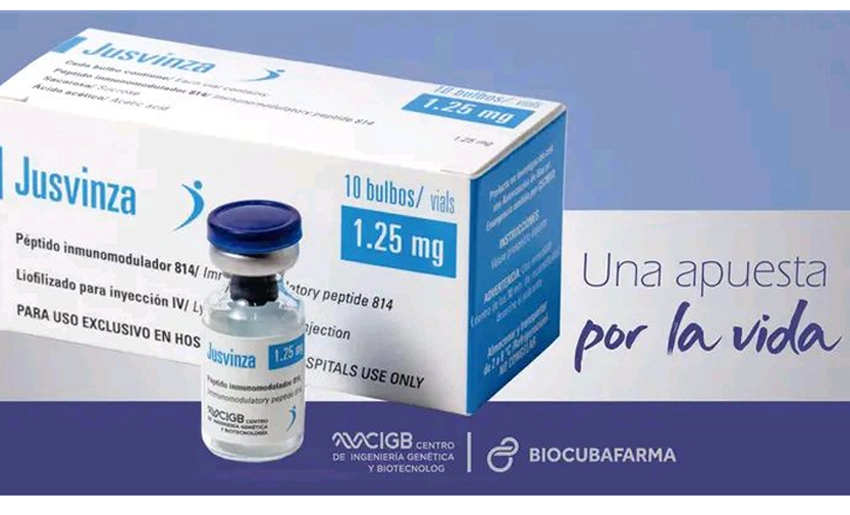
Cuba is conducting two clinical trials in chikungunya patients to demonstrate the safety and therapeutic effect of subcutaneous administration of the drug Jusvinza in patients in the post-acute and chronic phases.
This was announced during a meeting this Tuesday between Cuban President Miguel Díaz-Canel Bermúdez and health experts and scientists.
Dr. Julio Baldomero Hernández, director of clinical research at the Center for Genetic Engineering and Biotechnology (CIGB). Indicated that one of the trials is being carried out at the Diez de Octubre Clinical Surgical Hospital in Havana, in patients with joint symptoms.
According to the CIGB director, the study has good adherence to the protocol and the drug has been well accepted by the 174 patients included. He added that statistical and periodic reports of the clinical results will be available later. Among the objectives set, he said, is to evaluate the therapeutic effect of the drug in patients. As well as its durability over time, so that it does not progress to chronicity.
Another trial is being conducted at the Faustino Pérez Clinical Surgical Hospital in Matanzas province. With 120 patients in the chronic stage of the disease. Hernández indicated that the drug has shown a good safety profile, and its clinical results will be evaluated gradually.
Moreover the essential purpose, he said, is to determine how the use of Jusvinza impacts the improvement of clinical symptoms. Both clinical trials are based on proven scientific evidence regarding the use of the drug in rheumatoid arthritis.
In the case of chikungunya, arthritis symptoms are also present. But post-viral, hence the need to undertake clinical studies. Meanwhile, addressing the epidemiological situation in Cuba remains a priority. Some responses are being coordinated that range from primary healthcare and monitoring the epidemic’s behavior to applying scientific protocols in implementing actions.
During the meeting with the Cuban president, Dr. Carilda Peña, Vice Minister of Public Health, provided an update on the epidemiological situation at the close of the past week (week 50 of the year). Noting a more favorable trend than in the previous seven days.
The official indicated a 21.1 percent decrease in febrile syndromes compared to the previous seven days.
Regarding the dengue epidemic, she emphasized that seven provinces have rates higher than the national average: Las Tunas, Guantanamo, Pinar del Rio, Mayabeque, Ciego de Avila, Havana, and Santiago de Cuba.
Regarding chikungunya, he commented that reported cases also decreased by 12.3 percent. Also the number of patients in intensive care was 13 fewer than the previous week.
Dr. Raúl Guinovart, a mathematics expert and director of Science and Technology at the University of Havana, said that models for analyzing the behavior of arboviruses coincide with this improvement. But acknowledged that infections are expected to continue in the coming weeks.
With information from Prensa Latina

- Cuba Defends Its Independence and Sovereignty Against Threats - 18 de March de 2026
- Holguin bets on energy sovereignty through renewable sources - 18 de March de 2026
- Venezuela Wins Its First World Baseball Classic - 18 de March de 2026