
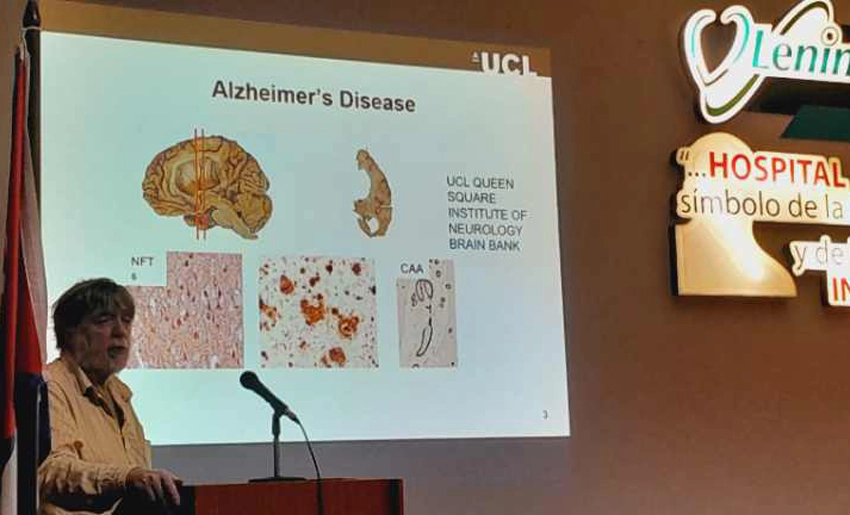
The city of Holguin hosted the 1st International Scientific Conference on Neurogenetics on December 10th. With the participation of Drs. John Hardy, Henry Houlden, Sigurlaug Sveinbjornsdottir, and Anupriya Dalmia, leading researchers from the United Kingdom. Also who have been visiting the Cuban City of Parks since December 8th.
The conference featured keynote lectures by both international and Cuban speakers. Among the international speakers, Dr. John Anthony Hardy stood out. Addressing global advances and genetic therapies for Alzheimer’s disease. While Dr. Henry James Houlden spoke about the genetics of Parkinson’s disease. Focusing on its differences and similarities with hereditary ataxias.
For his part, Dr. Luis Enrique Almaguer Mederos, who currently works in the Department of Neuromuscular Diseases at University College London. Presented the results of the collaborative project to identify biomarkers for Spinocerebellar Ataxia Type 2. According to the scientist from Holguin, the project aims to create a global genome map of patients with spinocerebellar ataxia type 2 (SCA). In order to identify genetic variants that modify the clinical presentation of the disease.
“Some patients with ataxia manifest the disease earlier, others later, and less severely, and we believe that one of the reasons that may explain this situation is the presence of genetic variants that modify the clinical presentation of the disease,” he added.
He mentioned that years ago at CIRH, where he worked for more than two decades. He participated in research aimed at identifying genetic variants that modify the disease using the technology available at the center and the candidate gene strategy. Now, University College London has the opportunity to take this research to the next level. Using advanced technology and state-of-the-art microarrays that cover more than 1.2 million genetic variants in the human genome.
Almaguer Mederos stated that these studies began in patients with SCA-2 and other types of ataxia. To identify genetic variants that modify the clinical severity of the disease. Also to identify pathogenic pathways relevant to the disease, and potential therapeutic targets for the development of therapies to help those affected.
Futhermore the presentations by Cuban researchers and geneticists addressed the clinical-molecular characterization of a series of patients with Usher syndrome from the province of Holguin. The presentations on fucosidosis in the region, characterization of cognitive impairment in Alzheimer’s disease. And the prognostic index of motor status after stereotactic functional surgery in Parkinson’s disease were given by Doctors of Science Elayne Esther Santana Hernández, Víctor Jesús Tamayo Chang, Pedro Enrique Labrada Aguilera, and Yanot González González.
The audience included medical students with an interest in neurology and related fields, healthcare professionals, and academics. John Anthony Hardy, a world-renowned neurogeneticist in the field of neurodegenerative diseases, is the Chair of Molecular Biology of Neurodegenerative Diseases at the Institute of Neurology, University College London. In 1991, his team discovered the first mutation directly implicated in Alzheimer’s disease.
The International Scientific Conference undoubtedly provided a unique opportunity for scientific Exchange. Where participants gained up-to-date knowledge from renowned researchers with established careers. Supported by scientific publications in high-impact journals on the management and care of patients with neurological, genetic, rare diseases, and movement disorders.
Meanwhile this event foreshadows the first steps toward what could become future collaborative projects between the United Kingdom and Cuba. Aimed at advancing research and therapies for ataxias and other neurodegenerative and genetic diseases with a high prevalence in Holguin.
In addition to opening the door to genetic diagnosis, which is currently unavailable in the region due to infrastructure challenges and limited technological resources. This visit could mark the beginning of clinical trials and the personalized determination of the most effective medications and dosages required by each patient.
This advances the study of molecular fluid biomarkers for ataxia, driven by the technology of the Institute of Neurology at University College London. Considered among the top five in the world for research in Neuroscience and Neurology.

- The 4th edition of the Master’s Program in Natural Medicine will begin in Holguin - 16 de January de 2026
- Blood Bank Inaugurated at Holguin Military Hospital - 15 de January de 2026
- Holguin Cancer Center Plans to Incorporate Endoscopic Surgery in Urology - 14 de January de 2026