
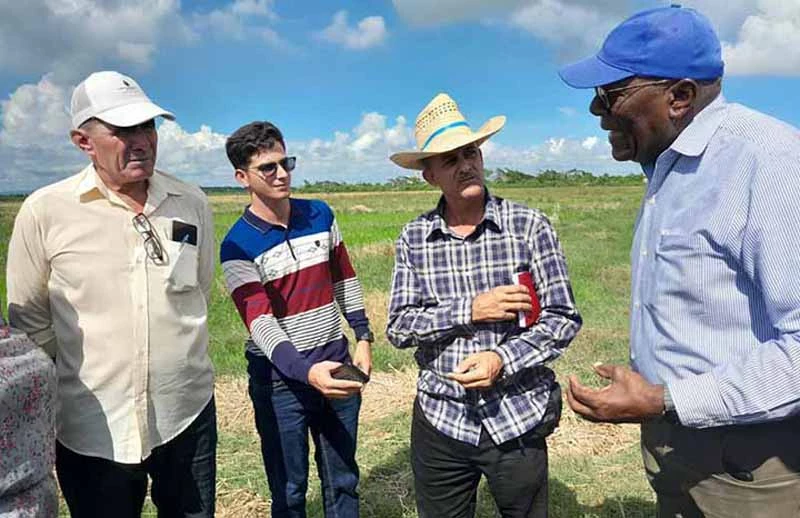
Vice President Salvador Valdés Mesa urged a necessary change of mindset within business structures. Amidst a process of transformation of the Cuban economy. During a working visit to the municipality of Mayari, in Holguin province, this Friday.
During the visit, the member of the Political Bureau of the Central Committee of the Communist Party of Cuba toured entities responsible for ensuring the rice program in the northeastern territory. Assessed the state of food production after Hurricane Melissa last October.
Without compromising principles or objectives, it is essential to change the methods of managing and controlling resources. As well as to promote the creation of supply chains that translate into greater efficiency. Aimed at strengthening agri-food production, Valdés Mesa emphasized during his visit to the Mayari Agro-industrial Grain Business Unit.
He pointed out that food production and the recovery of the electrical system are the country’s top priorities. Given their impact on the economy and the well-being of the population. Therefore, it is essential to utilize water reserves and the availability of land used for agriculture, with an emphasis on rice cultivation.
Enrique Roché Fernández, director of the agency, explained that the weather event damaged more than 60 hectares of planted rice. Resulting in the loss of approximately 100 tons of the grain intended for consumption and causing millions of dollars in economic losses to the sector.
Moreover he indicated that, although the damage reduced the capacity of the farmers, conditions are in place to fulfill the winter planting plan. Which covers 200 hectares, although the results may be limited by a lack of equipment and a fuel shortage.
The Vice President emphasized the need to guarantee the independence of the rice program in order to modernize and self-finance the sector, reduce costs, improve working conditions for farmers, and extend grain cultivation to municipalities near bodies of water such as the Cauto River, where there are wetlands with great potential.
He also called for strengthening alliances with state entities to provide financing for local production sources. Promote the cultivation of fast-growing and less complex varieties. Such as the popular rice variety, and organize their procurement to contribute to feeding the population.
In the Guaro district of Mayari, the Vice President spoke with both young and experienced farmers, such as 72-year-old Félix Zayas and Yaikel de la Cruz, who has managed four harvests, and inquired about best practices and the main challenges farmers face. With five hectares of land, Zayas explained that he has obtained a yield of 2.5 tons per hectare during the off-season. But he faces a lack of machinery to expedite harvesting and increase production. Leading to crop losses, and a cash shortage for paying wages to seasonal workers.
Given the limitations on implementing banking services, Valdés Mesa emphasized the need to address priorities such as informal workers, who lack social security. Authorities must create enrollment mechanisms that allow them to regularize their status and access benefits. As well as expedite wage payments to workers.
Among the main problems he encountered were the delay in agricultural investments, the mill’s energy dependence which halts grain processing, and the urgent need to complete the Nipe Deleite canal’s irrigation and drainage system to meet the population’s demand and increase the arable land dedicated to cereal cultivation. He added that it is essential to expand infrastructure, resolve obstacles in contracting without impositions, where non-compliance and violations persist. Also assume responsibility for the distribution and marketing of products, according to the needs of each region.
The Cuban Vice President was accompanied by Joel Queipo Ruiz, member of the Central Committee of the Communist Party of Cuba and first secretary of the Provincial Committee of that political organization, and Yunia Pérez Hernández, vice governor of Holguin, among other political and government authorities.
With information from the Cuban News Agency

- Sustainable Agricultural Practices Promoted in Holguin - 9 de March de 2026
- Cuban Woman, a Strength She Holds with Tenderness - 9 de March de 2026
- Holguin Exhibits Legacy of Visual Artists - 7 de March de 2026